
A funeral doesn’t have to mean choosing between a respectful farewell and financial security. If family or friends can’t arrange or pay for a funeral in Queensland and the deceased’s estate can’t meet the cost, the Queensland Government may organise a simple cremation or burial. If you’re deciding what to do if you can’t afford a funeral on the Gold Coast, you can contact the Coroners Court of Queensland on (07) 3239 6193 to ask about assistance. The Court may later recover the cost from the deceased’s estate or the applying spouse or parent.
It’s understandable to feel pressure to make arrangements quickly while grieving. A formal service isn’t the only way to honour someone: Queensland families aren’t legally required to hold a funeral service, viewing or memorial.
This guide explains how funeral assistance works, what to consider before committing to arrangements, and how direct cremation may offer a simpler, lower-cost path. You’ll also find practical options to explore, helping you understand the next steps with greater clarity.
Key Takeaways
- Explore available assistance before agreeing to arrangements, as some schemes may not help once the account is paid in full.
- If you use crowdfunding, explain the intended costs clearly and share updates so supporters understand how contributions will help.
- Consider whether a simpler cremation arrangement could meet your needs, while leaving room to remember the person in a way that feels right for your family.
- Clarify who is arranging the funeral and how costs will be handled, including whether funds from the deceased’s estate may be relevant.
What is a Pauper's Funeral?
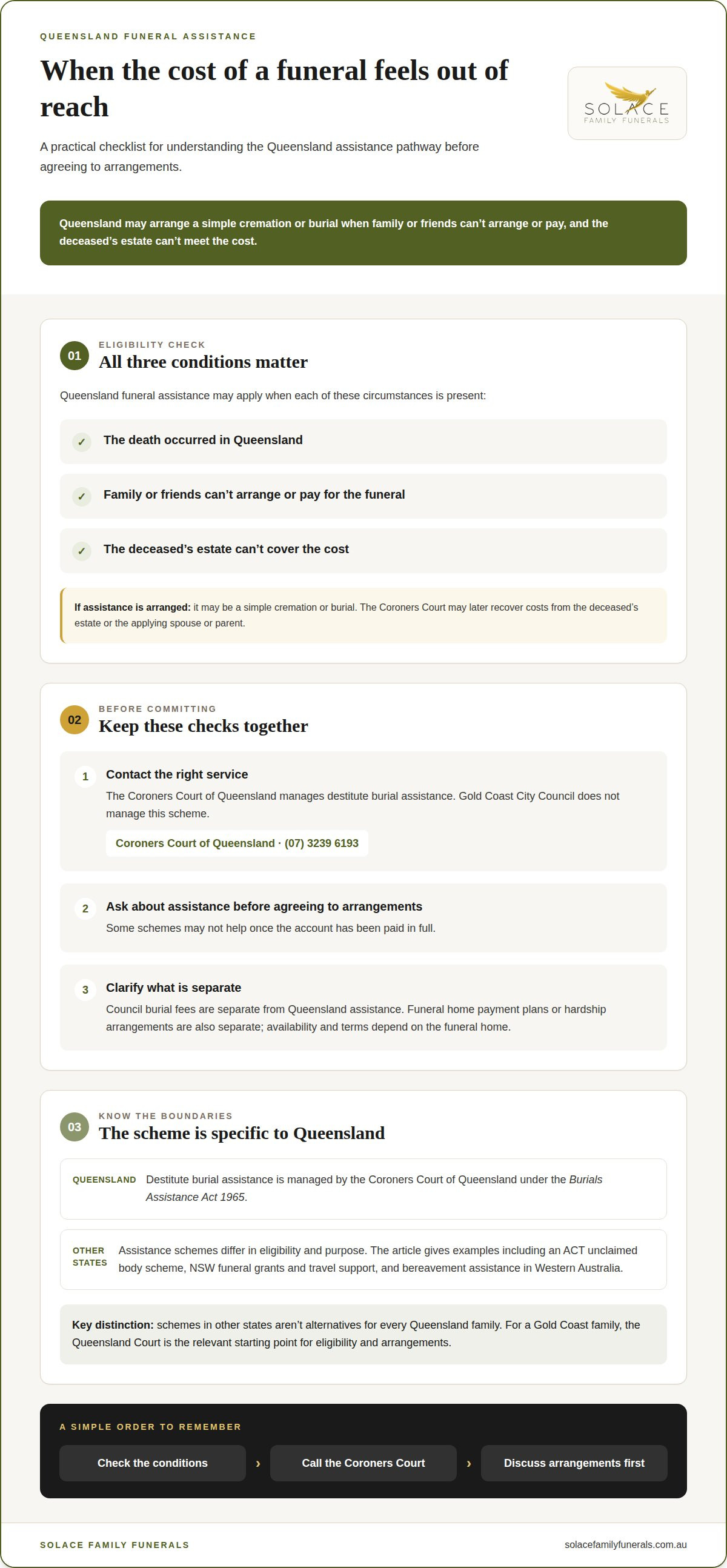
On the Gold Coast, a “pauper’s funeral” generally refers to government-arranged burial or cremation assistance. Queensland may arrange a simple cremation or burial if someone dies in Queensland, family or friends can’t arrange or pay for the funeral, and the deceased’s estate can’t cover the cost. These are the key eligibility conditions for Queensland funeral assistance.
Queensland destitute burials are managed by the Coroners Court of Queensland under the Burials Assistance Act 1965. The Court may later recover costs from the deceased’s estate or the applying spouse or parent. Before committing to funeral arrangements, contact the Court on (07) 3239 6193 to discuss the assistance process. This phone line is the practical starting point; the eligibility conditions guide whether the state route may apply.
Gold Coast City Council does not manage this Queensland assistance. The Coroners Court of Queensland manages destitute burial assistance, so contact the Court about eligibility and arrangements. Council burial fees are separate from this scheme.
Funeral homes’ payment plans or hardship arrangements are separate from government assistance. Terms depend on the funeral home’s arrangements, so don’t assume a payment plan is available or that it replaces an application to the Coroners Court.
Funeral assistance schemes differ across Australia. For example, the ACT may arrange a basic service through its Unclaimed Body Scheme when nobody can arrange or pay. In New South Wales, the Aboriginal Land Council offers funeral grants, while Transport NSW’s Aboriginal Funeral Support ‘Sorry Business’ fund can help with travel to funerals within NSW. Western Australia’s Department of Communities provides bereavement assistance.
These schemes have different eligibility rules and purposes, so they aren’t alternatives for every Queensland family. For Gold Coast families, the relevant starting point is the Coroners Court’s phone service for Queensland eligibility. If arranging a funeral elsewhere, look at the scheme for that state. Apply before agreeing to arrangements, as some schemes may not help once the account is paid in full.
Crowdfunding funeral expenses
An online fundraiser can give family and friends a practical way to contribute when funeral expenses feel difficult to manage alone. On the Gold Coast, a clear campaign can explain who is organising arrangements, what support is needed and how contributions will be used. Set a fundraising target using the funeral account or an itemised estimate, rather than choosing an amount without explaining its purpose.
Before sharing a campaign, agree who will manage it and receive the funds. One relative might coordinate contributions while another communicates with supporters. Explain whether donations will go towards funeral arrangements, close family’s travel or a later memorial. If arrangements change, update the campaign promptly so contributors know what has changed.
- GoFundMe: A dedicated fundraising page can bring the purpose, target and updates together in one place. Use plain language and describe the intended use of contributions.
- Facebook: Sharing a campaign through a family or community network can help people find the fundraiser. Keep the post respectful and link it to the same campaign page.
- A spreadsheet: A simple record can help the organiser track contributions, transfers and expenses. Limit access to people handling the funds, and avoid sharing private financial details publicly.
Protect the deceased person’s dignity when choosing photographs or sharing personal details. Ask close family before posting sensitive information, and use an image they’re comfortable making public. A short, sincere account of the person’s life can help supporters understand the request without making grief feel like a sales appeal.
Keep fundraising separate from confirmed arrangements. Tell the funeral director how contributions are being managed, and don’t treat a fundraising target as money already received. Keeping a written record of donations and payments can help the family communicate clearly and avoid misunderstandings. If fundraising is only part of the plan, explain that to supporters. A funeral director can also explain the available arrangements and provide a clear account to share.
Direct cremation as a lower-cost alternative
Direct cremation takes place without a formal funeral gathering beforehand. It may suit families seeking a simpler arrangement, while leaving them free to remember the person later. Because it doesn’t include a ceremony, it can cost less than arranging a service as well as cremation. Check what the quoted price includes before deciding.
Queensland families aren’t legally required to hold a formal funeral service, viewing or memorial. You can consider cremation without a ceremony beforehand, then decide whether to gather at another time. For example, relatives might meet at home later, when more family members can attend or contribute.
Ask for an itemised written quote before agreeing to arrangements. It shows which services are included and which choices affect the total. A written summary of decisions is also helpful when relatives share responsibility, as it records what the family has agreed to arrange.
- An itemised quote: Use it to understand the included services and any optional choices.
- A written arrangement summary: Use it to keep family decisions clear and consistent.
- A calendar: Use it to plan a later remembrance gathering around relatives’ availability.
Direct cremation may not suit your family if gathering beforehand is important. A full-service cremation includes a gathering before the cremation, while a memorial service allows the cremation and gathering to take place separately. The right choice depends on what matters most to your family, not on whether a formal ceremony is expected.
If you’re weighing up what to do if you can’t afford a funeral on the Gold Coast, compare the arrangements you need rather than assuming every family must hold the same kind of service. Ask the funeral director to explain the available choices clearly, including what each option covers. That gives you a practical basis for deciding whether a simpler cremation suits your circumstances.
Who organises and pays for a funeral in Queensland?
In Queensland, family members or friends often take the practical lead in arranging a funeral. The person making arrangements should understand which costs they’re agreeing to cover. Ask for a written invoice and clarify who will receive it before confirming decisions. This helps avoid confusion when one person organises arrangements and another manages payment.
Funeral expenses may be paid from the deceased person’s estate. Banks will generally release funds from a deceased person’s account directly to a funeral director when given an invoice. The invoice identifies the amount and recipient. As the bank’s process may depend on the account and documents provided, the executor can ask what the bank needs to consider payment. In situations where cash is limited, families might also look at liquidating physical assets such as coins or jewellery through specialist buyers like silverbuyers.com.au to help fund immediate costs.
Useful tools for organising payment include:
- The funeral director’s invoice: Shows the amount due and can support a request to release funds from the deceased’s account.
- Estate paperwork: Helps the executor manage the deceased person’s financial affairs and funeral expenses.
- A shared payment record: Lets relatives note who has paid or contributed, reducing misunderstandings.
Services Australia payments may also be relevant to an estate. If a single pensioner dies, Services Australia pays the regular payment for the fortnight in which the person died, and the executor can access it from the bank account. This is not a general funeral payment; it is the person’s regular payment for that fortnight.
Queensland requires a deceased person to be properly laid to rest by cremation or burial, and the death must be registered with the Registry of Births, Deaths and Marriages. A funeral director can guide the family through these arrangements while the person responsible for payment deals with the invoice and estate funds. If you need support arranging a respectful farewell, talk with a funeral director.
Solace Family Funerals
Solace Family Funerals can help you discuss arrangements when cost is a concern and decisions feel difficult. A conversation can clarify the kind of farewell you want, what matters most to your family and what can be simplified. Options include Direct Cremation, Family Viewing, Full Service Cremation, which includes a gathering before cremation, and Full Service Memorial.
If you’re considering assistance, share what you know about available funds and who is organising the arrangements. This gives the funeral team context to explain suitable options and their costs, without assuming one type of service will suit every family. You can take time to understand the choices before deciding.
For a compassionate conversation about arrangements, contact Solace Family Funerals.
Take the next step at your own pace
Deciding what to do if you can’t afford a funeral on the Gold Coast can feel like a lot to carry while grieving. You don’t need to settle every detail at once. Start by identifying what matters most to your family, then discuss arrangements that fit those priorities.
Solace Family Funerals offers Direct Cremation, Family Viewing and Full Service Cremation. Sharing your questions and circumstances can help you understand which arrangement may suit your family, and what choices are available before you decide how to proceed.
A conversation doesn’t commit you to a particular farewell. It can give you space to explain what you’re facing and consider the next step with care. Contact Solace Family Funerals for support when you’re ready. You deserve clear information and the time to make a considered decision.
Frequently Asked Questions
Can I get help paying for a funeral if I can't afford it?
Yes, support may be available through Queensland funeral assistance, the deceased’s superannuation or eligible bereavement payments. If nobody can arrange or pay and the estate cannot cover costs, the Queensland Government may arrange a simple cremation or burial. Before committing to arrangements, explore assistance because some schemes cannot help after an account is paid. For free financial counselling, call the National Debt Helpline on 1800 007 007.
Does Centrelink pay for a funeral?
Centrelink doesn’t provide a general funeral payment, but some people may qualify for bereavement payments based on their circumstances. A person who received Carer Allowance may be eligible for a lump sum of up to 14 weeks of payments after the person they cared for dies. Carer Payment may continue for up to 14 weeks. Entitlements can change, so contact Services Australia about the relevant payment.
Does the Department of Veterans' Affairs help with funeral costs?
Yes, eligible veterans or former Australian Defence Force members may qualify for help with funeral costs. At an executor’s request, the Department of Veterans’ Affairs can pay an eligible veteran’s funeral benefit directly to the funeral director. Veterans and former members can contact an Indigenous Veterans’ Liaison Officer on 1300 551 918 to discuss assistance. Eligibility and the circumstances of the death affect which support applies.
How much does a funeral cost?
There isn’t one fixed cost for every funeral; the total depends on the arrangements and choices involved. A formal gathering, burial, cremation and optional elements can all affect the quote. Ask for an itemised estimate that separates included services from optional choices. This helps you compare the arrangement with available funds and discuss adjustments before confirming decisions. The deceased’s estate may also be relevant to payment.
What Happens If You Can’t Afford a Funeral in Queensland?
If family or friends cannot arrange or pay, and the deceased’s estate cannot cover the cost, the Queensland Government may arrange a simple burial or cremation. The Coroners Court of Queensland manages destitute burial assistance under the Burials Assistance Act 1965. The Court may later seek to recover costs from the estate or the applying spouse or parent. Contact the Court before committing to arrangements.
What financial assistance is available for funeral costs in Queensland?
Options may include Queensland destitute burial assistance, eligible bereavement payments, superannuation and insurance held through super. If the person who died was dependent on you, ask your super fund about early access to your super for funeral costs. In severe financial hardship, the ATO may allow early release of your super on compassionate grounds for a dependent’s funeral. A free financial counsellor can help you consider these options.


