
What does it take to bring a loved one home after they die overseas? Repatriation services in Australia help coordinate the return of a person who has died, including transport and required documents. Straightforward cases may take one to two weeks, while returning remains can take several weeks. Costs vary according to the country, transport requirements and paperwork involved.
It’s understandable if the process feels difficult to take in while you’re grieving. Repatriation can involve arrangements in another country as well as decisions here in Australia, and the steps depend on where the death occurred and how your loved one will be returned.
This guide explains what repatriation involves, which documents and approvals may be needed, and what to expect when your loved one arrives in Australia. It also covers factors that can affect costs and how funeral or memorial arrangements fit into the next steps, helping you approach each decision with greater clarity.
Key Takeaways
- Repatriation paperwork can include death certificates, permits and translations, depending on the countries involved.
- When your loved one arrives in Australia, a funeral director can coordinate their transfer into care and guide you through funeral or memorial arrangements.
- Sharing cultural, spiritual or religious wishes early can help shape arrangements that feel respectful to your family.
- If an Australian has died overseas, people in Australia can contact the Australian Consular Emergency Centre on 1300 555 135, according to the Australian Department of Foreign Affairs and Trade.
What documents and approvals are required for repatriation?
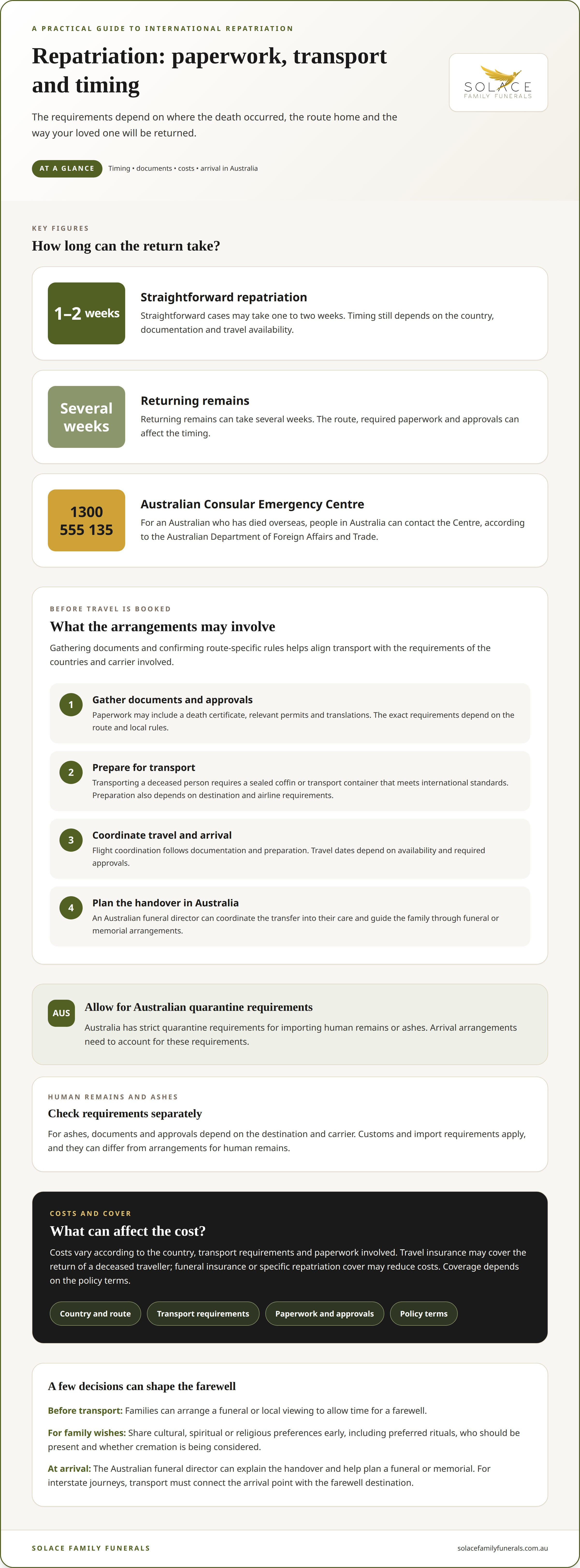
Repatriation services in Australia coordinate transport, documentation and approvals between countries. Arrangements commonly involve death certificates, permits and any translations required by the destination country. The paperwork varies with the route and local rules. Australia also has strict quarantine requirements for importing human remains or ashes, so arrival arrangements must account for these requirements.
The required transport documents are gathered before travel is booked. These may include a death certificate and relevant permits, while documents in another language may need translation. Transporting a deceased person requires a sealed coffin or transport container that meets international standards. Preparation depends on the destination’s rules and the airline’s requirements.
When transporting ashes from Australia internationally, the documents and approvals required depend on the destination and carrier. The paperwork may include a death certificate, permits and translations, and the destination’s customs and import requirements also apply. Confirming these requirements before travel can help prevent avoidable delays.
Returning human remains from Australia to another country involves coordinating destination requirements with transport arrangements. The practical steps include gathering the death certificate and permits, arranging necessary translations, preparing an approved transport container, and coordinating travel and arrival. Local rules at the destination determine the process, so the documents must match the route.
Timing depends on the country, documentation and travel availability. Straightforward repatriation to Australia may take one to two weeks, while returning remains can take several weeks. Travel insurance may cover the return of a deceased traveller, and funeral insurance or specific repatriation cover may reduce costs. Coverage depends on the policy terms.
Families can arrange a funeral or local viewing before transport to allow time for a farewell. Flight coordination follows the documentation and preparation, while travel dates depend on availability and required approvals. For ashes, check the destination’s requirements separately from those for human remains, as customs and transport arrangements can differ.
What happens once my loved one arrives back in Australia?
After an overseas return, an Australian funeral director coordinates the transfer of your loved one into their care. The next steps are to confirm your family’s wishes, discuss a funeral or memorial, and organise a suitable time and place. For an interstate journey, transport must also connect the arrival point with the farewell destination.
Arrangements differ depending on whether the death occurred overseas or in another Australian state. For an overseas death, the country where it happened determines how the death is handled and how remains are cared for. The death certificate and transport documents support the handover and help the Australian funeral director plan the next steps.
Across Australian states and territories, practical steps focus on transfer into care and funeral planning. Next of kin don’t have to register an overseas death in Australia, but may contact their state or territory births, deaths and marriages registrar if they wish to do so. This is separate from arrangements in the country where the death occurred.
If a death happens overseas, start by locating the travel insurance details and identifying the next of kin who will coordinate decisions. They may need to appoint funeral directors in both the country of death and Australia. They don’t have to travel overseas to arrange the return. Local authorities determine the process in the country where the death occurred.
When your loved one arrives, the Australian funeral director can explain the handover, discuss meaningful ways to say farewell, and guide you through service planning. The next decisions may include whether you want a funeral or memorial, who should be involved, and how cultural or family wishes will shape the gathering. If you’re ready to consider those arrangements, explore funeral and memorial options.
Will cultural or religious customs be respected during the repatriation process?
Your family’s cultural, spiritual and religious wishes can guide arrangements, including the farewell in Australia. Share practical needs early, such as preferred rituals, who should be present and whether cremation is being considered. This gives the funeral director clear guidance and helps shape plans that reflect what matters to your family.
For an overseas death, local authorities decide how the death is handled and how remains are cared for. Customs and requirements differ between countries, so a family’s preferred practices may need to fit local procedures and transport arrangements. Government authorities in the country of death, rather than Australian family members, determine those local processes.
To communicate cultural or religious needs clearly, write down key requests and identify a family representative to explain them. For example, note the preferred form of farewell or whether particular relatives need to take part. A consulate may help communicate about an Australian who has died overseas, while local authorities remain responsible for handling the death.
Cremation is one decision that depends on the country where the death occurred. If your family is considering it, understand the local process and arrangements for bringing ashes home together. The same care applies to other customs: distinguish what your family requests from what local rules and transport arrangements allow.
Once your loved one returns, share the same preferences with the Australian funeral director. This carries important details from the overseas arrangements into the service here, so family members don’t have to repeat decisions during a difficult time. A clear conversation can cover who to involve, the tone of the farewell and any rituals to include.
Repatriation services in Australia can help coordinate family wishes across borders. The process varies by country because local authorities control the handling of remains and customs differ. Keeping your family’s priorities clear while accounting for local requirements helps create arrangements that honour your loved one.
International funeral repatriation
Returning a person who died overseas involves coordination between the country of death and Australia. Local authorities decide how the death is handled and how remains are prepared. The Australian Government doesn’t organise or pay for burial or cremation overseas, and Australian embassies and consulates don’t pay repatriation costs. Knowing this helps families plan the practical arrangements.
People in Australia can contact the Australian Consular Emergency Centre about an Australian who has died overseas on 1300 555 135, according to the Australian Department of Foreign Affairs and Trade. Consular staff can assist with information about local processes. They don’t take over decisions made by authorities in the country where the death occurred.
Which Australian funeral directors handle international repatriation? Arrangements may involve a funeral director in the country of death and another in Australia. NSW Government notes that appointing both may be necessary to coordinate local requirements, permits, paperwork and the return of remains. Their roles connect preparation overseas with care and arrangements after arrival.
Your next of kin doesn’t have to travel overseas to arrange the return. A practical first step is to choose who will communicate family decisions, then coordinate with the funeral directors involved. Local authorities determine how remains are handled, so the process varies between destinations.
Travel insurance may cover the return of a deceased traveller’s remains, while specific repatriation or funeral insurance may reduce costs. Policy terms and transport requirements determine what support applies. If cremation is permitted in the country of death, returning ashes may be more cost-effective than transporting a body.
For help planning the Australian farewell after your loved one returns, discuss funeral arrangements.
Solace Family Funerals
Solace Family Funerals can help arrange a funeral or memorial for your loved one in Australia. As their return is coordinated, you can discuss the kind of farewell that feels right for your family and the practical choices involved.
Options include Family Viewing, Full Service Cremation and Full Service Memorial. The right arrangement depends on your wishes, whether you want a viewing and how you’d like family and friends to gather. You can talk through the choices without deciding everything at once.
If you’re ready to discuss the next steps for a local farewell, contact Solace Family Funerals.
Take the next step at your own pace
After an international return, you can focus on what matters most for your family’s farewell. Choosing repatriation services in Australia is one part of the process; deciding how to remember your loved one is another. You don’t have to settle every detail at once. Start with the kind of gathering you have in mind, then discuss arrangements that may suit.
Solace Family Funerals offers Direct Cremation, Family Viewing and Full Service Cremation, giving families different ways to shape a farewell. You can discuss your wishes and practical next steps in a straightforward conversation, without pressure to decide before you’re ready.
If you’d like to talk through funeral arrangements for your loved one, contact Solace Family Funerals. A thoughtful next step can begin with a simple conversation.
Frequently Asked Questions
What is repatriation?
Repatriation means returning someone who has died overseas or interstate so they can be laid to rest with family. It involves more than transport: arrangements connect the place of death with the family’s plans in Australia. For example, relatives may plan a local farewell after the person arrives or bring ashes home following cremation overseas.
Can you help bring my loved one home from any country?
A return from overseas can require coordination between the country where the death occurred and Australia, with local authorities determining how remains are handled. Procedures and transport arrangements vary by country, so there is no single process that applies everywhere. The country, required documents and travel availability all shape the practical steps and timing.
Can I still hold a funeral service before repatriation?
Yes, families can hold a local viewing or funeral before a loved one’s body is transported. This gives nearby relatives and friends an opportunity to gather before the journey. The timing and form of the farewell must fit arrangements in the country where the death occurred, including the preparation required for transport.
Can ashes be repatriated instead of a body?
Yes, ashes can be brought across borders, but destination import and transport requirements still apply. If cremation is permitted in the country where the death occurred, returning ashes may be more cost-effective than transporting a body. Before arranging travel, consider the paperwork and permissions needed for the ashes alongside the destination’s rules.
Do Australian embassies help pay for repatriation costs?
No. Australian embassies and consulates don’t pay repatriation costs, and the Australian Government doesn’t pay for or organise burial or cremation for Australians who die overseas. Families need to consider how transport and funeral arrangements will be funded. Travel or funeral insurance may provide relevant cover, depending on the policy and circumstances.
How much does funeral repatriation from Australia cost?
Costs depend on the country, transport requirements and documentation, so they vary from case to case. A quote reflects the route, preparation and transport arrangements, and required paperwork. Travel insurance, funeral insurance or specific repatriation cover may reduce what a family pays if the policy covers the situation.


