
What if a meaningful farewell didn’t need to follow a set ceremony template? When you’re grieving, deciding what a memorial should look like can feel like another weight to carry. A memorial service on the Gold Coast can be held without the casket present, often after cremation, giving your family more flexibility around when and where to gather. For families considering a memorial service Gold Coast arrangements can be shaped around personal wishes, rather than a standard format.
It’s natural to be unsure how a memorial differs from a funeral, or how to bring everyone’s wishes together. The right approach is one your family can plan with care, whether that means a quiet gathering or a service with personal tributes.
This guide explains your options and the practical choices that shape a personal farewell, from timing and venue to the ceremony itself. You’ll also find ways to use music, readings and shared memories to make the service feel true to the person you’re remembering. Solace Family Funerals is a locally family-owned funeral home on the Gold Coast. Its full service memorials can be arranged around your wishes, with transparent, all-inclusive pricing.
Key Takeaways
- A memorial service Gold Coast families plan can reflect their wishes, with the gathering held without the casket present.
- Choosing when to gather gives family and friends space to come together at a time that feels right.
- Consider the venue’s atmosphere and accessibility, as well as the size of gathering that suits your family.
- Start with a few essentials: your family’s wishes, preferred timing, likely guests and the kind of farewell you have in mind.
- A local, family-owned funeral home can help clarify arrangements and shape a personal full service memorial with transparent, all-inclusive pricing.
What is a memorial service on the Gold Coast, and when might it feel right?
After someone dies, your family may need time and space before coming together. A memorial service lets you choose a later moment to remember them, without the casket present. That flexibility can give relatives time to travel, allow family members to talk through their wishes, or make the gathering feel more manageable.
At its heart, a memorial is a gathering focused on remembrance. It might include stories, music, readings, prayer or quiet reflection, shaped around the person and the people who loved them. The memorial service tradition takes different forms across cultures and communities, so there’s no single programme your family needs to follow.
A memorial may take place after cremation or at another time chosen by the family. The ceremony and arrangements for a person’s remains are related, but separate decisions: a memorial describes how people gather to remember, while burial or cremation describes what happens to the person’s remains. A memorial can be meaningful whether or not ashes are present.
How does a memorial service differ from a funeral service?
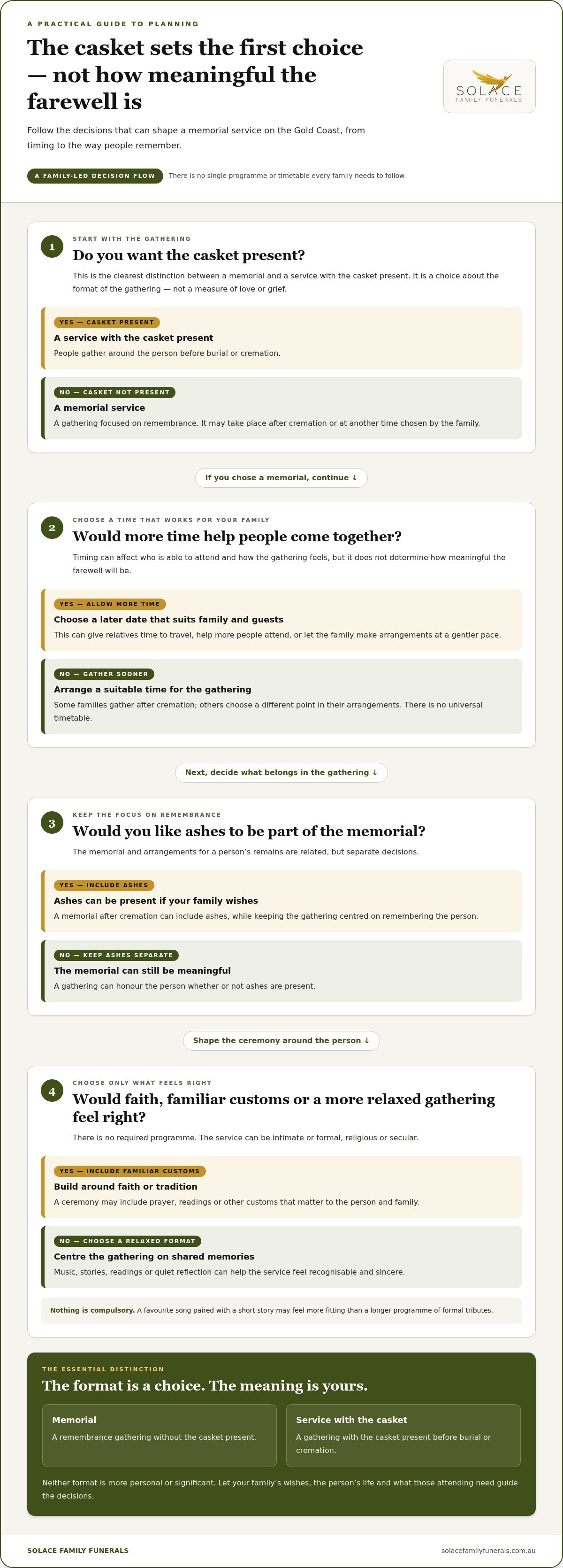
The clearest difference is whether the casket is present. A memorial is a remembrance gathering without the casket; a service with the casket present brings people together before burial or cremation. Neither format is more personal or significant. A memorial service Gold Coast families choose can be intimate or formal, religious or secular, just like a service with the casket present.
The distinction is about the gathering, not a measure of love or grief. Your family can decide which arrangement feels right without feeling that one format is expected.
When might a memorial service suit a Gold Coast family?
Flexible timing can help when close relatives live interstate or overseas, or need time to make travel arrangements. It can also give everyone the chance to meet after a private cremation, or let the family choose a date that feels meaningful. There’s no universal timetable for remembering someone.
Family, cultural and personal wishes matter. Some people may value a faith-based ceremony or familiar customs; others may prefer a relaxed gathering centred on shared memories. Families can also have different views, so it may help to begin with what mattered most to the person who died and what those attending need from the occasion. The gathering doesn’t have to look a certain way to honour them.
For some, a quiet moment with a small circle feels most fitting. Others may want to invite a wider group of friends, colleagues and community members. Either can offer space to remember and support one another. Choose an approach your family can manage with care, at a pace and in a way that feels comfortable.
How can memorial service timing and format shape the farewell?
There isn’t one sequence every family needs to follow. Some gather after cremation, while others choose a later date that gives relatives time to travel or lets the family make arrangements at a gentler pace. Timing can affect who is able to attend and how the gathering feels, but it doesn’t determine how meaningful the farewell will be.
A memorial ceremony is about remembering the person; burial or cremation is a separate decision about their remains. A memorial may follow cremation, but families can also plan a gathering at another suitable point in their arrangements. The comparison below can help you identify what might fit your family.
| Format | Timing | Casket present? | Possible focus |
|---|---|---|---|
| Memorial after cremation | After the cremation, at a time arranged for the gathering | No | Coming together to remember, with the option of including ashes if the family wishes |
| Memorial at a later chosen time | On a date that suits the family and guests | No | Making space for more people to attend or for a gathering to reflect the family’s wishes |
| Service with the casket present | Before burial or cremation | Yes | Gathering around the person before the next arrangement takes place |
These are broad distinctions, not a fixed timetable. A later chosen date can also be after cremation, so the first two memorial formats may overlap. The practical question is often whether your family wants to gather soon or would value more time to bring people together.
Can a memorial ceremony take place after cremation?
Yes. A family may hold a memorial after cremation, leaving more flexibility to choose a date and bring relatives together. One possible sequence is to arrange a direct cremation on the Gold Coast, then hold a separate memorial gathering. Other families choose a different order or format, depending on their wishes.
The focus remains on the ceremony: sharing memories, offering support and recognising the person’s life. Ashes may be part of the gathering if the family wants, but they don’t have to define it. Plan the memorial around what feels comfortable for those attending.
What can a memorial service include?
Possible elements include a celebrant, readings, music, a moment of reflection or time for guests to share memories. None is compulsory. A favourite song paired with a short story, for example, may feel more recognisable and sincere than a longer programme of formal tributes. Choose only what helps the gathering feel true to the person.
Solace Family Funerals arranges full service memorials around each family’s wishes.
Which memorial service choices matter most for your Gold Coast family?
Once you’ve decided to gather, a few choices can help the occasion feel comfortable and personal: where to meet, who to invite and which parts of the person’s life to share. You don’t need to plan an elaborate ceremony. Start with what would help those attending feel welcome and connected, then work through the details.
How do you choose a setting for a Gold Coast memorial?
A chapel may offer a quiet, purpose-suited setting, while a church can feel familiar for families connected to a faith community. Another chosen venue may feel more personal. Consider travel, parking, seating and step-free access, as well as whether older guests, children or anyone with mobility needs can be comfortable there.
For an outdoor gathering, consider the season and the possibility of heat, rain or wind. Before settling on a venue, find out about access, booking arrangements and practical requirements for sound or weather. The right setting is not necessarily the most striking one; it’s the place that suits the people who will be there.
How can the ceremony reflect the person being remembered?
Consider a favourite piece of music, a reading, photographs or stories that capture something distinctive about the person. A familiar song and one honest memory can feel more personal than a long programme of tributes. Choose contributions that feel comfortable for your family, and remember that guests can take part without speaking publicly.
Religious, non-religious and blended elements can all have a place, depending on the person’s beliefs and the family’s wishes. You might include a prayer alongside personal reflections, or keep the ceremony secular while making room for quiet remembrance. There’s no need to use stock themes or polished language if they don’t feel true.
Guest numbers affect both the atmosphere and practical arrangements. A smaller gathering may give close family and friends room to share memories privately. A broader invitation can make space for colleagues, neighbours or community members who also want to pay their respects. Neither choice is more meaningful. If you’re unsure, consider who the person would have wanted included and what feels manageable for those organising the day.
- For the setting: weigh atmosphere against travel, access, seating and comfort for guests.
- For the guest list: choose a gathering size that feels right, rather than inviting people out of obligation.
- For the ceremony: include only the traditions and personal details that genuinely fit.
If your family is also considering a ceremony with the casket present, a full service cremation follows a different format. A memorial service Gold Coast families arrange can be shaped around their own wishes, with the venue, guest list and ceremony elements considered together rather than treated as a fixed template.
How to plan a memorial service on the Gold Coast, step by step
Planning a farewell while grieving can feel like a lot to hold at once. Take each decision in turn, beginning with what matters to your family rather than trying to settle every detail straight away. A simple plan can give you direction while leaving room for the ceremony to take shape.
For a memorial service Gold Coast families can personalise, think of the arrangements as a series of manageable choices: the purpose and timing, the people to invite, the place to gather and the details that will make the ceremony feel familiar.
What should you decide before arranging the ceremony?
Start with a brief family conversation. Note the kind of gathering you have in mind, a preferred date range and an approximate sense of who may attend. These are starting points, not commitments. Agreeing who will coordinate contributions and share updates can also prevent one person from carrying every task.
- Clarify the purpose. Consider whether you want a quiet remembrance, a faith-based ceremony or a broader gathering for the person’s community.
- Set a timing and guest-list guide. A preferred date range and rough guest numbers can help narrow venue choices without requiring an exact plan immediately.
- Choose a suitable venue. Consider atmosphere, travel and access for guests, then find out about the chosen location’s booking and practical requirements.
- Shape the ceremony. Decide whether a celebrant would help, then consider readings, music, photographs and personal tributes that feel right.
Record cultural or religious wishes, accessibility needs and any dietary considerations early. This gives your family time to plan with care, rather than discovering a practical need just before the day. If relatives have different preferences, focus first on needs that affect the venue or ceremony structure, then work through the smaller details together.
How can you prepare guests for the day?
Once the arrangements are taking shape, send guests clear details about the venue, arrival time and useful access information. A gentle note about the ceremony’s tone can help people know what to expect, whether the gathering will include prayer, shared memories or quiet reflection. If you’d like guests to contribute readings or stories, explain how they can do so, while making it clear that speaking is optional.
Before invitations are final, revisit the venue’s access arrangements and, for an outdoor setting, its weather plan. Clear information can ease uncertainty for guests and leave your family with fewer last-minute questions.
Planning support from a local funeral home can help make the arrangements easier to work through. Solace Family Funerals offers full service memorials for Gold Coast families, with the ceremony shaped around their wishes.
How Solace Family Funerals supports a memorial service on the Gold Coast
Making arrangements while grieving can leave you unsure which decision to make first. Solace Family Funerals is locally family-owned and operated on the Gold Coast, offering personal guidance as you consider the choices for a memorial. Talk through the kind of gathering you have in mind, what matters to your family and which practical decisions need attention. A farewell doesn’t have to follow a standard pattern.
A full service memorial can take place without the casket present or following cremation. The location and timing can be shaped around your family’s wishes, giving you room to consider what feels comfortable and who you hope to bring together. Whether you have a clear idea or are still working out what might feel right, planning can begin with what you know.
What support can families expect when arranging a memorial?
Support begins with listening. Talk through the choices that shape the ceremony, such as its general format, timing and location, and receive clear explanations as you consider what suits your family. This can help separate decisions that need attention now from details you can work through later.
Your preferences guide the planning. A family may have cultural or religious considerations, different views about the gathering, or practical needs to keep in mind. Respectful guidance means taking those wishes seriously and helping clarify the options, rather than steering every family towards one standard format. You remain at the centre of the decisions.
Clear pricing matters, too. Solace Family Funerals provides transparent, all-inclusive pricing, helping families understand the arrangements without unclear charges. You can discuss what the service involves and how the choices relate to your plans, giving you a clearer picture as decisions are made.
What is a helpful next step for a Gold Coast family?
You don’t need to have every detail settled before beginning a conversation. It may help to share a few starting points: whether you’re considering a memorial without the casket present or after cremation, what timing might suit your family, and where you hope to gather. You can also talk about the people you’d like to bring together and any wishes you want the ceremony to reflect.
From there, the discussion can make the next choices clearer. Solace Family Funerals can listen, explain the arrangements in plain language and help you shape a personal farewell around your wishes. You can take one decision at a time.
Speak with Solace Family Funerals about the memorial you have in mind. You don’t need to arrive with a finished plan; sharing what matters to your family is enough to begin.
Begin with what you want people to remember
You don’t need to have every detail settled before taking a first step. It may be enough to think about what you hope family and friends will carry with them after the gathering: a story, a sense of connection, or simply the comfort of having been together. That intention can guide the choices still ahead.
If you’re considering a memorial service Gold Coast families can shape around their own wishes, Solace Family Funerals offers full service memorials without the casket present or following cremation, with flexibility around location and timing. Transparent, all-inclusive pricing can make the arrangements clearer as you consider what suits your family.
There’s no need to have all the answers before you speak with someone. Share what matters to you and take the next decision at a pace that feels manageable. Talk with our family about planning a memorial service. A thoughtful farewell can begin with one simple conversation.
Frequently Asked Questions
Is a memorial service religious?
No, a memorial service doesn’t have to be religious. The family can choose a faith-based ceremony, a non-religious gathering or a blend that reflects the person’s beliefs and the needs of those attending. For example, you might include a prayer alongside personal reflections, or choose music and readings without religious elements. If guests come from different backgrounds, a brief note in the invitation can help them know what to expect.
Can children attend a memorial service?
Yes, children can attend if the family feels it’s appropriate and the gathering is suitable for them. Consider the child’s age, how well they knew the person and whether a trusted adult can stay close by. A simple explanation beforehand, such as who will be there and what they may see or hear, can help them feel more settled. It’s also fine to let a child step outside with an adult if they need a break.
What should I wear to a memorial service?
Choose respectful, comfortable clothing, guided by any dress request from the family. Black isn’t essential; subdued colours or a neat outfit that suits the venue are usually considerate choices. For an outdoor gathering on the Gold Coast, check the forecast and consider sun protection or a light layer. If the invitation suggests a particular colour or style of dress, follow that guidance rather than guessing.
Do guests need to bring flowers to a memorial service?
No, flowers aren’t expected unless the family has requested them. Some families may prefer no flowers, while others might welcome a simple bunch or a single stem. Check the invitation for guidance, especially if the gathering is at a venue where flowers may be difficult to place. A card with a brief message or a shared memory can be a thoughtful way to express care without bringing a gift.
Can guests share memories without speaking in front of everyone?
Yes. You can write a memory in a card, send a message to the family or offer a few words privately after the ceremony. If the family is collecting stories, ask how they’d prefer to receive them and whether they’re comfortable with the memory being shared more widely. A short, specific recollection, such as a favourite saying or a small act of kindness, can mean a great deal without requiring a public speech.
How long does a memorial service usually last?
There isn’t one set duration; it depends on the ceremony’s format, the number of contributions and whether time is included for guests to gather afterwards. A service with several readings or speakers may take longer than a brief, quiet remembrance. For a memorial service Gold Coast guests are travelling to, it can help to share an expected finish time in the invitation, while allowing some flexibility for farewells and conversation.


