

If you’re wondering what happens at a graveside service, knowing the usual order can make the day feel a little less uncertain. It’s understandable to feel anxious, especially if you’re unsure about the committal or what to say to the family.
There isn’t one fixed script. The service can reflect the family’s wishes, and a funeral director can guide the arrangements and ceremony. Knowing what to expect may help you feel more prepared, while remembering that it’s okay if your emotions come and go.
This guide explains the usual flow, from arriving at the graveside to the final farewell, including what you may see during the committal. It also covers practical preparation for an outdoor gathering, such as choosing comfortable footwear and clothing for the weather, and deciding what to bring or say. If you feel overwhelmed, you don’t need perfect words or a composed face to be there for someone.
Key Takeaways
- Knowing what happens at a graveside service can help you feel more prepared, though each farewell may follow its own order.
- Get a gentle preview of the usual sequence, from arrival at the grave to the final farewell.
- You don’t have to speak, pray or make a particular gesture; being present is enough.
- Prepare for an outdoor gathering with directions, suitable footwear and clothing for the weather.
- Families can shape the ceremony with a funeral director’s guidance, including through Solace Family Funerals’ graveside burial service on the Gold Coast.
What happens at a graveside service, and what is it for?
Not knowing what to expect can add strain when you’re already grieving. The simplest picture of what happens at a graveside service is a farewell held at the grave. Those gathered honour the person and usually take part in the committal, the part of the ceremony connected with placing them in their final resting place. It offers a shared moment to pause, remember and say goodbye.
There’s no single script. A graveside service may be the main ceremony, or it may follow a service held elsewhere. The family’s wishes, beliefs and circumstances shape the farewell, including who leads it and which words or customs are included. For some families, faith is an important part of the ceremony. Christian burial traditions and graveside ceremonies offer one example of how religious rites may be part of a burial, though practices differ between communities and families.
How a graveside service differs from a full funeral service
A graveside service takes place at the cemetery. It may be a graveside-only farewell, with the ceremony held at the grave, or the burial may follow a separate service at another location. In the second arrangement, the cemetery gathering is one part of a wider farewell. Neither format is more meaningful or appropriate by default. The choice depends on what suits the person being remembered and those close to them.
The setting makes the farewell direct: everyone gathers at the place of burial, and the committal is part of the occasion. The ceremony may include spoken tributes, religious or cultural practices, or a quieter moment together. What matters is that it reflects the family’s wishes, not that it follows a particular template.
Who may be present at the graveside?
The gathering may include family, friends and others who were close to the person. The number of people depends on the family’s arrangements and wishes. You might find yourself among a close circle of relatives or a wider group who have come to pay their respects. Each gathering has its own shape.
A funeral director can guide the family through arrangements and coordinate proceedings, so attendees know where to gather and when the ceremony is beginning. This support can be useful when people are unsure what to do, or when the family is balancing personal, cultural or faith-based wishes. You don’t need to know the customs in advance to attend respectfully. The service can be organised around the family, with guidance to help the gathering feel considered and personal.
The usual order of events at a graveside service
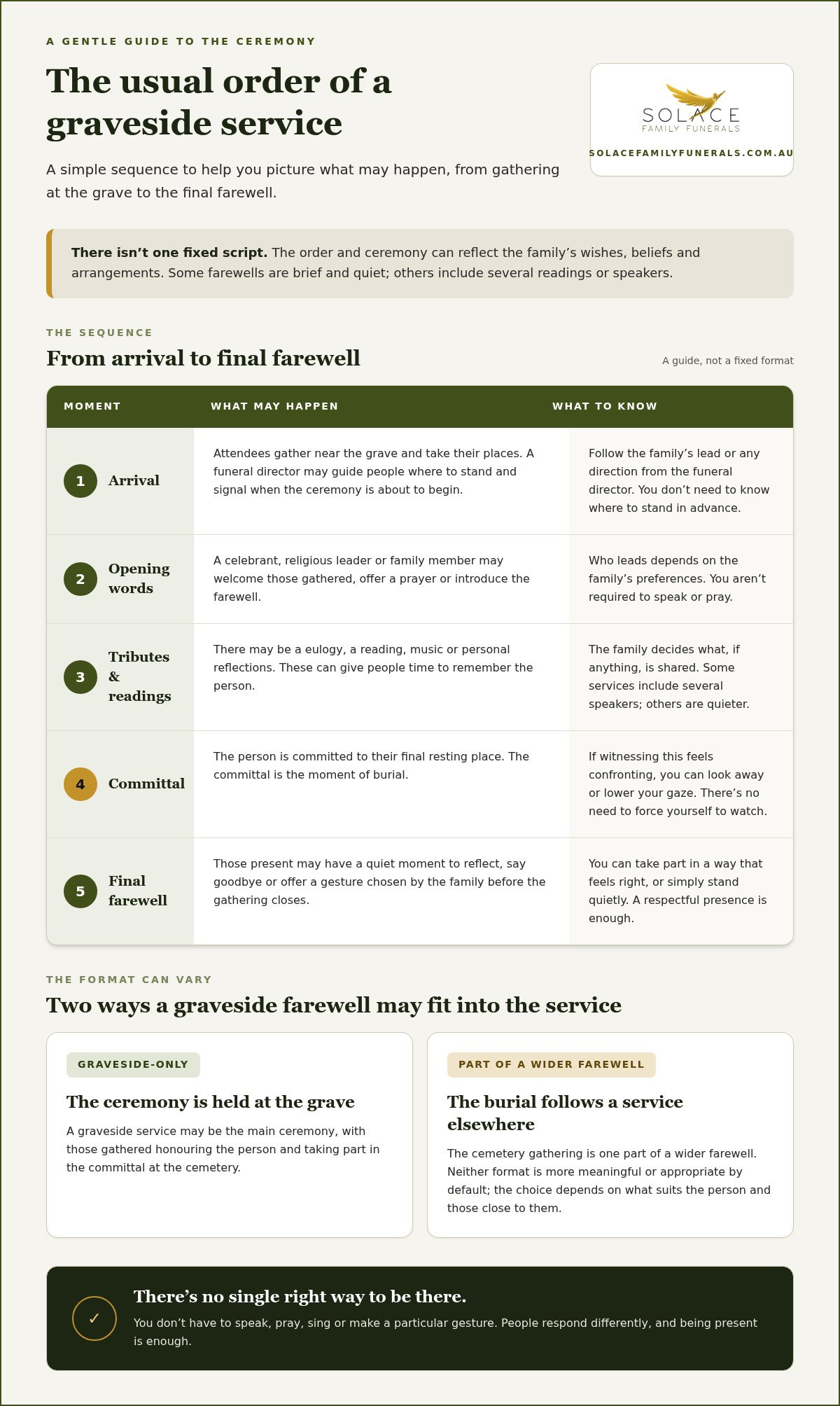
If you’re unsure what happens at a graveside service, a simple sequence can help you picture the gathering. Treat this as a guide, not a fixed script: the order and ceremony vary with the family’s wishes, beliefs and arrangements. Some farewells are brief and quiet; others include several readings or speakers.
- Arrival: Attendees gather near the grave and take their places. A funeral director may guide people where to stand and signal when the ceremony is about to begin.
- Opening words: A celebrant, religious leader or family member may welcome those gathered, offer a prayer or introduce the farewell.
- Tributes and readings: There may be a eulogy, a reading, music or personal reflections. The family decides what, if anything, is shared.
- Committal: The person is committed to their final resting place. The committal is the moment of burial.
- Final farewell: Those present may have a quiet moment to reflect, say goodbye or offer a gesture chosen by the family before the gathering closes.
From arrival to the start of the ceremony
People usually gather close to the graveside and settle into place. You don’t need to know where to stand or when to speak in advance. Follow the family’s lead or any direction from the funeral director. Once everyone is gathered, opening words or a prayer may begin. A celebrant, religious leader or family member can lead, depending on the family’s preferences.
The committal and the final farewell
Readings, reflections or eulogies may be shared before the committal, giving people time to remember the person and hear words chosen for them. The committal is a significant moment, and it’s understandable if you feel uncertain about witnessing it. You can look away or lower your gaze if that feels more comfortable; there’s no need to force yourself to watch. Afterwards, people may pause quietly or offer a farewell in their own way. Not everyone responds in the same way, and that’s all right.
The sequence can be adapted to create a personal gathering rather than follow a standard format. A funeral director can help the family coordinate the ceremony and guide proceedings, keeping the focus on the farewell they want to hold. Families arranging a burial on the Gold Coast can explore Solace Family Funerals’ graveside burial service, with a formal committal at the chosen cemetery.
What may feel difficult, and what is not required of you
A graveside farewell can bring sadness, numbness, uncertainty or several feelings at once. You might feel emotional, focus on practical details or not know what you feel until later. There’s no correct response, and attending doesn’t need to bring closure or resolve grief. You’re there to remember someone in a way that feels possible for you in that moment.
You aren’t expected to speak, pray, sing or make a particular gesture. If others share a tribute or bow their heads, join in if it feels right, or simply stand quietly. A respectful presence is enough. The family’s customs may shape what happens and who takes part. Following their lead can help you feel more at ease without needing to copy every action.
If witnessing the committal feels confronting
People experience the burial in different ways. You may want to watch, look elsewhere or focus on something that helps you stay grounded. There’s no need to predict how you’ll feel or judge your response. If the moment feels difficult, you could listen to a reading, notice the people beside you or take a quiet pause. Follow your own comfort while being mindful of the family and any guidance given during the service.
If you need space, a small step back may help. You can also focus on a familiar detail, such as the words being spoken or the sound of someone’s voice. These are options, not instructions. You don’t have to manage your feelings in a particular way for your attendance to matter.
Religious, cultural and personal touches
The family’s beliefs and preferences can influence the ceremony. It may include prayers, readings, music or a period of silence. Some families choose a religious service, while others prefer a non-religious farewell. Neither choice is more valid. A reading or symbolic gesture may feel meaningful to one family and not suit another, so treat these as possibilities rather than expected parts of every gathering.
Customs can also guide who leads a prayer, shares a tribute or takes part in a particular moment. If you’re unfamiliar with what’s happening, you can remain respectfully quiet and follow the family’s cues. There’s no need to know every tradition beforehand. A funeral director can help coordinate proceedings and provide gentle direction, while the family decides which elements reflect the person being remembered.
Your feelings may also change during the gathering. You may feel steady at first and become upset later, or experience the reverse. There’s no timetable for grief, and a single ceremony can’t determine how you should feel afterwards. Give yourself room to respond as you do, without comparing your reaction with anyone else’s.
How to prepare for attending a graveside service
Knowing what happens at a graveside service can help you feel more settled, but a little practical preparation matters too. Cemeteries are outdoor settings, and getting from your arrival point to the gathering may involve uneven ground or standing for a while. A few simple checks can make the day easier.
- Check the directions: Confirm the cemetery location and any arrival instructions shared by the family or funeral director. If you’re unfamiliar with the area, allow time to find the entrance and gathering place.
- Plan your arrival: Aim to arrive with enough time to join the group without rushing. Follow any guidance about where to meet and when the service will begin.
- Dress for the setting: Choose respectful clothing suited to an outdoor ceremony and any guidance from the family. Check the forecast and prepare for sun, wind or rain.
- Think about comfort: Wear shoes that feel steady on grass or uneven paths. Consider bringing sun protection or an umbrella if the weather calls for it.
Clothing, weather and personal comfort
There isn’t one required outfit for every graveside service. Neat, respectful clothing is considerate, and comfort matters if you’ll be outdoors. A light layer can help if conditions change, while a hat or sunscreen may be useful on a sunny day. If rain is possible, take an umbrella or waterproof layer. Choose footwear you can walk and stand in comfortably, rather than shoes that may feel difficult on grass or gravel.
Think about the conditions as well as the occasion. You may be standing in the open, so bring what you’ll find useful and keep your hands free if possible. There may not be shelter or seating nearby, so plan for your comfort without assuming those facilities will be available.
Arrival, access and considerate support
Give yourself time to reach the cemetery, locate the gathering and settle before the ceremony starts. If you have mobility concerns, consider the route from your arrival point and how long you may need to stand. You could attend with someone who can support you, or follow any access guidance shared by the family or funeral director. If you’re unsure where to go, a funeral director can guide attendees and coordinate the gathering.
If you’re close to the family, practical support can be more reassuring than searching for perfect words. Offer to help with a simple task, ask whether they’d like company or quietly give them space. Their needs may change during the day, so a gentle offer without pressure is often enough.
If you’re helping a family consider arrangements as well as preparing to attend, the graveside burial service guide outlines broader options. For personal guidance with a graveside burial on the Gold Coast, talk with Solace Family Funerals about arranging a service that reflects the family’s wishes.
Arranging a graveside service with calm, personal guidance
Planning a farewell while grieving can feel like a lot to hold at once. You don’t need to settle every detail immediately. A funeral director can guide you through the arrangements, explain the choices and help coordinate the ceremony, so you can consider what feels right for your family one step at a time.
Families arranging a burial on the Gold Coast can choose a graveside burial service with Solace Family Funerals. This provides a formal committal at the chosen cemetery. A traditional burial may also include a service before everyone proceeds to the cemetery, giving family and friends time to gather for a ceremony before the burial. The right arrangement depends on the family’s wishes and circumstances.
Making the ceremony feel personal
Personal touches don’t have to make a service elaborate. You might choose a reading, a few words about the person, music or a quiet moment together. Some families prefer a simple ceremony with little spoken, while others want several people to contribute. There’s no required combination. The aim is to make choices that feel fitting, rather than trying to include every possible element.
It can help to think about the tone you want: quiet and reflective, shaped by faith or centred on personal memories. You may also consider who you’d like to participate, if anyone. A funeral director can talk through your preferences and help coordinate the ceremony around them. If you’re not sure yet, that’s all right. You can begin with what matters most without deciding every detail at once.
What support from a funeral director can help with
A funeral director can help bring the arrangements together and guide the family through the ceremony, including coordinating proceedings at the graveside. This can ease some practical responsibility at a time when decisions may feel difficult. You can discuss the tone, participants and ceremony elements at a manageable pace, and ask for explanations when something is unfamiliar.
It may be useful to start with a few questions: Would you like a service only at the grave, or a ceremony before proceeding to the cemetery? Who would you like involved? Are there words, music or customs that feel important? You don’t need polished answers. Even a broad sense of how you hope the farewell will feel can help begin the conversation.
Knowing what happens at a graveside service can make the day feel more familiar, but each family’s farewell remains personal. If you’re considering a graveside burial, you can talk with Solace Family Funerals about the arrangements and the kind of farewell that feels right for your family. A gentle first discussion can help you understand the next steps.
Take the next step at your own pace
Knowing what happens at a graveside service can ease some uncertainty, but every family’s decisions are personal. You don’t need a complete plan before beginning a conversation. It may be enough to share what matters most or ask about the choices in front of you.
Solace Family Funerals is locally family-owned and operated on the Gold Coast, supporting families with graveside burial services and traditional burials with a service. A funeral director can help you talk through your preferences and consider a farewell that feels right for your family, without needing to decide everything at once.
If you’re ready to explore what a graveside farewell could look like, begin a conversation with Solace Family Funerals. Take the time you need and start with one question or preference.
Frequently Asked Questions
How long does a graveside service usually last?
There’s no set duration for a graveside service. The length depends on the family’s wishes and the readings, speakers or traditions they choose. A brief committal may be part of a longer gathering, or the graveside service itself may be the main farewell. If you need to plan transport or other commitments, ask the family or funeral director about the expected schedule and allow a little flexibility rather than watching the clock.
Do I have to watch the coffin being lowered?
No, you can respond to the committal in the way that feels manageable for you. Some attendees stay close, while others focus on a reading, the people beside them or a quiet thought. You might choose where to stand so you can look away if needed. Follow any guidance from the family. Being present respectfully doesn’t require you to witness every part of the burial.
Can children attend a graveside service?
Families may decide to include children, but the best approach depends on the child and the family. Consider their age, what they’ve been told and whether a trusted adult can stay close and answer questions. Before attending, you could explain in simple, honest language that people will gather to say goodbye and that the child can ask for a break. The family’s wishes should guide attendance and participation.
What should I say to someone after a graveside service?
A simple, sincere expression of sympathy is enough. You might say, “I’m thinking of you,” share a kind memory or offer a specific form of help, such as bringing a meal another day. If words don’t come, listening quietly can still show care. Try not to expect a reply or ask the grieving person to reassure you. Let them accept support, change the subject or have a little space.
Is a graveside service always religious?
No, a graveside service can be religious or non-religious. Prayers or other faith customs may be part of the ceremony if they reflect the person’s or family’s beliefs. A family might instead choose a reading, music, personal reflections or a quiet pause. If you’re attending and unsure whether to join a prayer or ritual, you can remain quietly respectful and follow the family’s lead without taking part.
Can I attend a graveside service if I did not know the person well?
If you’ve been invited, or the family has welcomed others to attend, you can offer quiet support even if you didn’t know the person closely. Follow any directions about where to gather and avoid taking a prominent role unless invited. You could briefly introduce yourself to the family and offer condolences, then give them room to speak with others. A considerate presence matters more than having a close personal story to share.


