

A death at home doesn’t always mean you need to call the police. If the death is sudden or unexpected, call Triple Zero (000), according to the Queensland Government; police and ambulance officers attend, and police may notify the Coroner’s Court of Queensland. If the death was expected and the cause is known, contact the person’s doctor or palliative care team instead. These first steps after a death at home can feel difficult, but you can take them one at a time.
It’s understandable to feel unsure about what to do, especially when you’re also supporting those around you. Knowing the first steps after a death at home can help you focus on who to contact, how to tell family and friends, and what’s involved in registering the death.
As you work through the first steps after a death at home, you’ll also need to consider when a transfer can be arranged. Official confirmation of death comes first, but you don’t need to rush the immediate decisions.
Key Takeaways
- For a sudden or unexpected death at home, call Triple Zero (000). If the death was expected, contact the person’s doctor or palliative care team.
- Wait for official confirmation of death before arranging transfer into a funeral director’s care; you can take time with your loved one before removal.
- Tell close family and friends in a way that feels manageable, then keep a separate list of organisations to notify as you gather the necessary documents.
- In Australia, register the death with the relevant state or territory Births, Deaths and Marriages registry, usually within five days; a funeral director can usually assist.
- Once you’re ready to discuss arrangements, learn how Direct Cremation and other options can support your family’s wishes.
Contacting a funeral director
Contact a funeral director once official confirmation of death has been documented. Arrangements can begin within a few hours, but they don’t have to start immediately.
Once the required paperwork is complete, you can discuss transfer into care. In Queensland, police and ambulance officers may also determine whether an unexpected death needs referral to the Coroner’s Court of Queensland.
- Wait for official confirmation before arranging transfer. A funeral director can’t take the deceased into their care until confirmation of death is documented. If police or ambulance officers attend an unexpected death, follow their guidance. In some circumstances, the case may be referred to the coroner; this does not, by itself, imply wrongdoing. The Coroner’s Court of Queensland may need to consider the circumstances before transfer can proceed.
- Contact a funeral director when the paperwork is complete. You can call to discuss what needs to happen before the funeral and how transport and care will be arranged. A transfer team often aims to arrive at the home within an hour of being contacted, although the timing depends on the circumstances and required approvals. Ask what documents are needed, who will attend, and what will happen next, so family members know what to expect.
- Choose someone who explains the process clearly. You may speak with more than one funeral director before deciding. Ask each to explain the arrangements they can make, what is included, and how they will respect the deceased’s wishes. A clear conversation can help you understand the difference between a simple cremation, a family viewing, or a funeral service. You don’t need to settle every detail during the first call.
- Gather written wishes and donation preferences. Look for the will, funeral instructions, advance care directive, and any trusted contact list. Check for religious requirements and organ or tissue donation preferences, too. Keep the will intact, including its staples, and don’t write on or alter it. If documents are stored in a known place, ask a family member to retrieve them while you speak with the funeral director.
- Compare arrangements before deciding what feels right. Families may compare funeral services before speaking with a director or making a choice. Consider who wishes to attend, whether family members want time for a viewing, and whether a ceremony matters to them. Some families prefer a private arrangement, while others want a service that brings relatives and friends together. Arranging the funeral and carrying out the deceased’s last wishes usually happen within a week of their death, so note questions as they arise and discuss them at a pace you can manage.
Informing family and friends
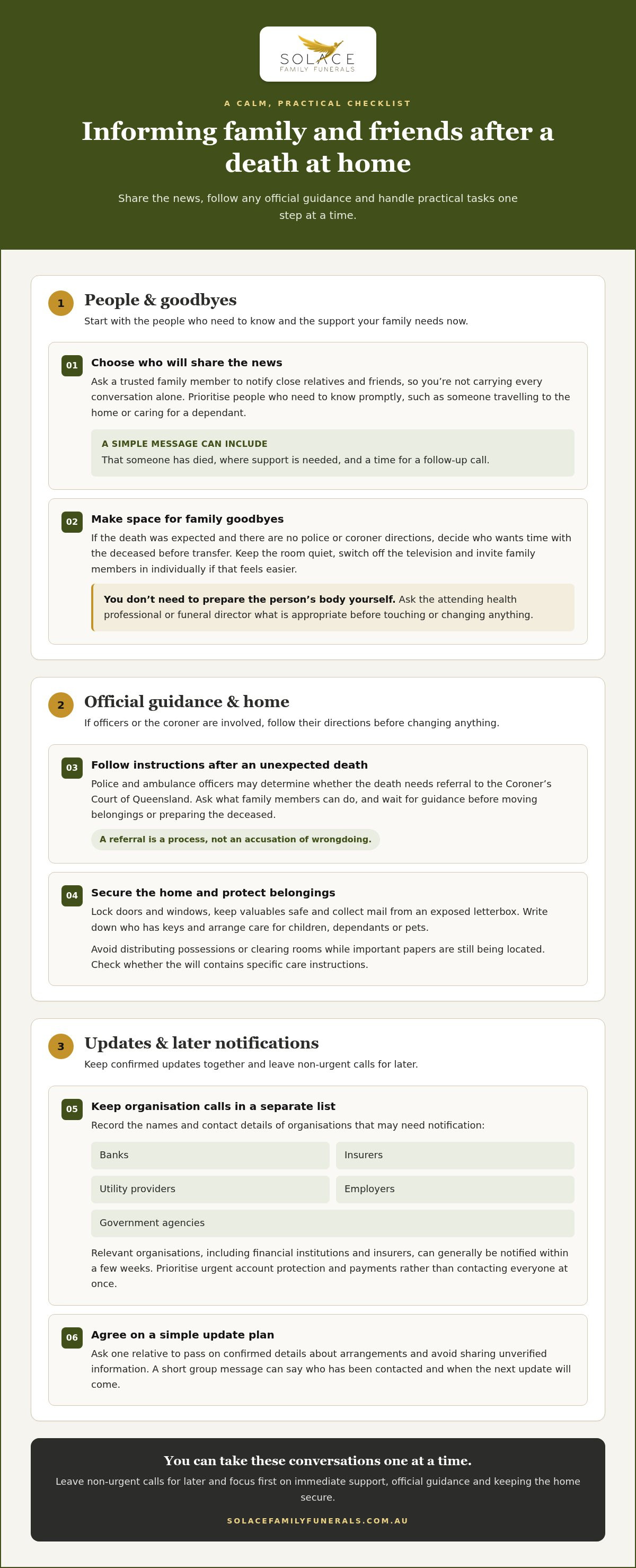
After someone dies, tell close family, organise practical support, and secure the home. Assign one person to manage calls and another to arrange care for children, dependants, or pets.
After an unexpected death, follow police or coroner directions before preparing the deceased or changing anything at home. Make a list of organisations to notify and leave non-urgent calls for later.
- Choose who will share the news. Ask a trusted family member to notify close relatives and friends, so you’re not carrying every conversation alone. Start with people who need to know promptly, such as someone travelling to the home or caring for a dependant. Use a direct, gentle message: say that someone has died, explain where support is needed, and offer a time for a follow-up call.
- Make space for family goodbyes. If the death was expected and there are no police or coroner directions to follow, decide who wants to spend time with the deceased before transfer. Keep the room quiet, switch off the television, and invite family members in individually if that feels easier. You don’t need to prepare the person’s body yourself. Ask the attending health professional or funeral director what is appropriate before touching or changing anything.
- Follow instructions after an unexpected death. Police and ambulance officers may determine whether the death needs referral to the Coroner’s Court of Queensland. If officers are attending or the coroner is involved, ask what family members can do and wait for guidance before moving belongings or preparing the deceased. A referral is a process, not an accusation of wrongdoing.
- Secure the home and protect belongings. Lock doors and windows, keep valuables safe, and collect mail from an exposed letterbox. Don’t distribute possessions or clear rooms while the family is still locating important papers. Write down who has keys and arrange care for children, dependants, or pets. Check whether the will contains specific care instructions.
- Keep organisation calls in a separate list. Record the names and contact details of banks, insurers, utility providers, employers, and government agencies that may need notification. Relevant organisations, including financial institutions and insurers, can generally be notified within a few weeks. Prioritise urgent account protection and payments rather than trying to contact everyone at once.
- Agree on a simple update plan. Ask one relative to pass on confirmed details about arrangements, and avoid sharing unverified information. A short group message can say who has been contacted and when the next update will come. If you need help discussing a farewell, you can talk through funeral arrangements when you’re ready.
How do you register a death in Queensland?
In Queensland, deaths are registered with the state’s Registry of Births, Deaths and Marriages. The steps below explain the documents and process involved in Australia.
- Obtain the medical certificate of cause of death. This certificate can be part of the paperwork for death registration and funeral arrangements. It is provided by the doctor who confirmed the death or by the coroner. Keep it with other important papers, and ask the funeral director how it will be used for the arrangements.
- Use the registry for the state where the death occurred. In Australia, deaths must be registered with the Births, Deaths and Marriages registry for the relevant state or territory. For a death in Queensland, contact the Queensland registry. Requirements vary slightly between states and territories, so the process elsewhere may differ from the local one.
- Keep the usual registration time frame in mind. A death must be registered within a specified period, usually within five days. A funeral director will usually assist with registration and explain what information and paperwork are needed. If you’re managing the process yourself, gather the medical certificate and relevant personal details before completing the registry requirements.
- Order certified death certificates for later tasks. After registration, the relevant state registry issues the death certificate. Organisations may require formal evidence before updating their records, so families may need multiple certified copies. The certificate can take a number of weeks to arrive, depending on Births, Deaths and Marriages processing times. Keep copies safely and note where each one is sent.
- Check donor registration as soon as practical. Families can check a deceased person’s organ and tissue donor registration on the Australian Organ Donor Register. Look for any known donor preferences or related documents as well. Share relevant information with the healthcare team, who can consider it as part of the immediate next steps.
- Keep registration separate from other notifications. You don’t need to contact every bank, insurer, or service provider immediately. First, track registration and any certificate order. Then use the death certificate when organisations request formal proof. A funeral director can usually assist with registration, while you keep applications, documents, and follow-up tasks in one place.
How long can my loved one remain at home?
After an expected death, families may keep their loved one at home for several hours before arranging transfer. The timing depends on confirmation, paperwork, and whether the death needs coroner review.
Arrange medical confirmation of death
After an expected death at home, contact the deceased person’s doctor or the palliative care team if they were involved. A doctor can confirm the death and explain what happens next. If the death was sudden or unexpected, call emergency services instead. Police and ambulance officers may assess whether the Coroner’s Court of Queensland needs to be notified.
Complete cause-of-death certification and paperwork
Ask which clinician will provide the Medical Certificate of Cause of Death, the document needed for registration and funeral arrangements. The doctor who confirmed the death, or the coroner, provides the certificate. A doctor must certify the death before further funeral or legal arrangements can proceed. The certificate is commonly called a Form 9; keep it safely with other important papers.
- Follow the expected-death process. If the person had been receiving medical care, contact their doctor or palliative care team. The doctor can complete the Medical Certificate of Cause of Death. A palliative care nurse may complete a Life Extinct form, with the doctor finalising the certificate afterwards. Police don’t need to be called when the death was expected and the cause is known, such as after a long illness.
- Let emergency services guide an unexpected-death response. Call Triple Zero (000) if the death is sudden or unexpected. Police attend and the coroner is notified; officers may determine whether referral to the Coroner’s Court of Queensland is needed. If a coroner investigates, examination and enquiries may take days before the deceased is released to a funeral director. This can affect when transfer and cremation arrangements proceed.
- Take time together while the required steps are underway. After an expected death, several hours at home may give close family and friends time to say goodbye before transfer. You don’t need to arrange removal immediately. Ask the doctor or palliative care team what paperwork remains, then discuss timing with the funeral director once confirmation is documented. A coroner’s involvement changes the process, so follow the directions given for that case.
Arranging removal of the deceased from home
Removal can be arranged once official confirmation of death is documented. After an expected death, you can spend time with your loved one before deciding when transfer should happen.
- Establish whether transfer can proceed. A funeral director can’t take the deceased into their care until official confirmation of death is documented. After an expected death, the doctor or palliative care team can explain what paperwork remains. Keep forms together and ask what must be completed before transport can be arranged. This clarifies the next step without assuming removal has to happen immediately.
- Contact a funeral director when the paperwork is ready. Explain that the death occurred at home, whether it was expected, and which health professionals have attended. The director can discuss transport and care, and explain what happens during transfer. Share access details, such as a locked gate or stairs, so the team can plan for the home.
- Follow police and coroner directions after an unexpected death. Police and ambulance officers may determine whether the death needs referral to the Coroner’s Court of Queensland. If the coroner is involved, the deceased may be transferred to a state mortuary for examination. The coroner’s process must take place before release to a funeral director, so don’t arrange a transfer independently.
- Tell the funeral director about any delay or change. If a doctor is still completing paperwork or the coroner has become involved, pass that information on before arranging transfer. The cause of death and required approvals affect what can happen next. If you’re unsure what has been completed, contact the health professional or officer already involved and ask which document or decision is outstanding.
- Decide how much time family members need. After an expected death, families may keep their loved one at home for several hours before arranging transfer. Use that time for quiet farewells, or ask the director to discuss timing with you. There’s no need to rush the transfer simply because arrangements have begun. Consider the wishes of those gathered and any practical directions from the professionals involved.
- Prepare the home for the team’s arrival. Choose a clear route from the room to the entrance, and let the funeral director know about access needs or family members who want to be present. Keep pets safely elsewhere during the transfer, and move personal items only when they’re in the way. For help discussing the next transfer steps, contact Solace Family Funerals.
Solace Family Funerals: Direct Cremation
Solace Family Funerals can help you consider Direct Cremation once the immediate steps and required paperwork are underway. If you’d like time with your loved one before cremation, Family Viewing may suit your family’s wishes. A Full Service Cremation or Full Service Memorial offers another way to gather and remember together.
There’s no single right choice. Consider whether family members want a gathering, a viewing, or a simpler arrangement, then discuss what feels appropriate for your circumstances. The aim is to make the next decisions clearer, without adding pressure while you’re grieving.
Contact Solace Family Funerals to talk about the arrangements.
Take the next decision at your own pace
The first steps after a death at home can leave you managing practical decisions alongside grief. You don’t have to settle every detail at once. Consider what would feel right for the people closest to the person who has died, whether that means a quieter farewell or time together in remembrance.
Solace Family Funerals offers Direct Cremation, Family Viewing, and Full Service Cremation. You might begin by deciding whether a viewing or shared service matters to your family, then talk through the options with someone who will listen and explain them clearly. Your farewell can reflect your family’s wishes, not anyone else’s expectations.
When you’re ready to discuss what may suit your family, contact Solace Family Funerals on the Gold Coast. Take it one conversation at a time. There is a way forward, and you can choose it with care.
Frequently Asked Questions
Do I have to call police when someone dies at home?
Call Triple Zero (000) if the death is sudden or unexpected. Police and ambulance officers attend, and the Coroner’s Court of Queensland may be notified. If the death was expected and the cause is known, contact the person’s doctor or palliative care team instead. The first steps after a death at home depend on whether the death was expected, so explain the circumstances clearly when you call.
Who do you need to notify first?
First, contact the right professional for the circumstances: emergency services after an unexpected death, or the doctor or palliative care team after an expected death. Then tell close family members who need to be involved or supported. Choose one trusted person to share updates, so relatives receive consistent information. A friend can help make calls, arrange meals, or care for pets while you focus on immediate needs.
Can I stay with my loved one after their death?
Yes, after an expected death, families may spend several hours with their loved one before transfer. Invite close relatives to say goodbye, sit quietly together, or take time for a personal ritual. If police or the coroner are involved after an unexpected death, follow their directions before touching or moving anything. The coroner’s process may affect when the deceased can be transferred.
How do medical certificates and coroners affect the timeline?
The Medical Certificate of Cause of Death is needed for registration and funeral arrangements, and is provided by the doctor who confirmed the death or by the coroner. A doctor must certify the death before further funeral or legal arrangements proceed. If a coroner investigates a sudden, unexpected, accidental, violent, or unexplained death, enquiries may take days before the deceased is released to a funeral director.
How do you support children, relatives and yourself?
Give children simple, honest explanations suited to their age, and let them ask questions without pressure. Ask a trusted adult to stay with them or manage school and meals. Check whether dependants or pets need immediate care, and consider compassionate or bereavement leave from work. Grief can last weeks, months, or, in some cases, years, so accept practical help from friends and relatives.
What are the next steps?
As you work through the first steps after a death at home, write down who attended, what instructions they gave, and which documents are still needed. Keep one family contact responsible for updates, and set aside a folder for registry paperwork and funeral notes. Address urgent care needs, such as arranging supervision for dependants, before routine notifications. Banks, utilities, and other organisations can be contacted as the necessary documents become available.
What documents and digital access should you secure?
Gather the will, funeral instructions, advance care directive, identity and relationship records, insurance policies, and pension or benefit details. Also note where property papers, tax records and bank information are kept. Secure the person’s phone, computer and two-factor authentication devices, and preserve access details for the executor or solicitor. Don’t alter the will or remove its staples; keep original papers together and record their location.
What funeral care decisions are needed in the first 48 hours?
Use the first 48 hours to clarify who will organise arrangements, locate any funeral wishes, and decide whether family members want a viewing or gathering. A funeral service isn’t a legal requirement in Australia, so families can consider what best reflects the deceased’s wishes. Record questions about transfer, ceremony preferences and paperwork in one place, then discuss them with the person coordinating arrangements.


