
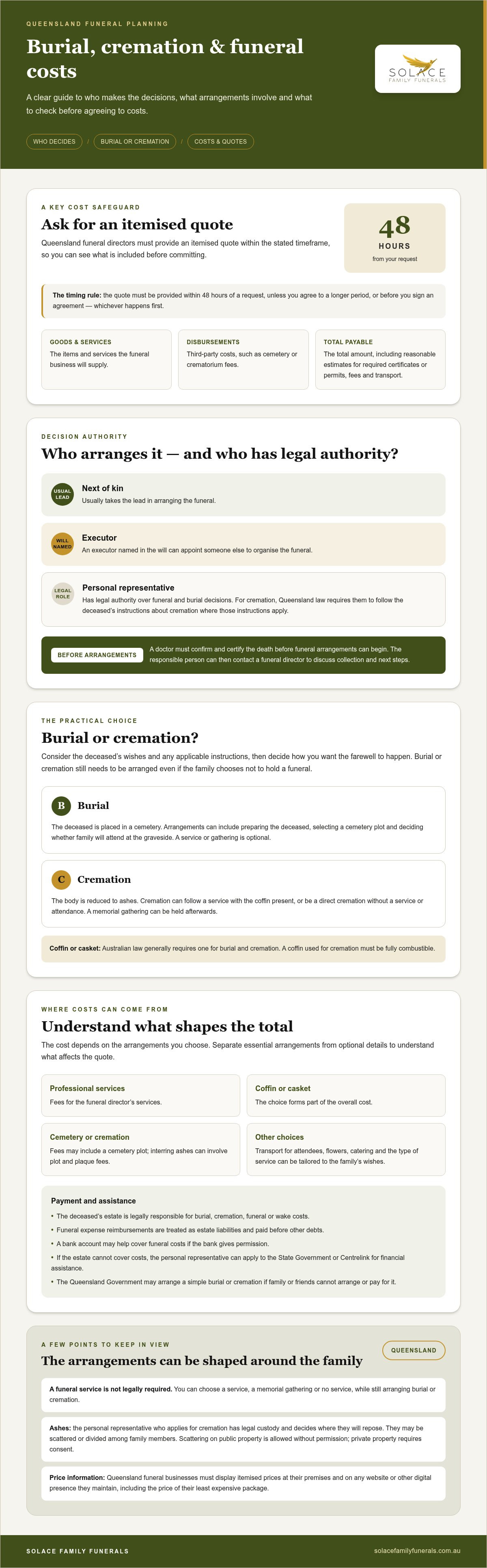
In Queensland, the next of kin usually arranges the funeral, while an executor named in the will can appoint someone else to organise it. A doctor must confirm and certify the death before funeral arrangements can begin. After that, the person responsible can contact a funeral director to arrange collection and discuss the next steps.
It’s understandable to feel unsure about who is responsible while coping with a recent loss. The person legally responsible for funeral and burial decisions may not be the one who usually takes the lead, and cremation has separate considerations. Knowing the difference can help you decide what to do next.
This guide explains how to arrange a funeral in Queensland, including who can make decisions, how to choose burial or cremation, and what to consider when planning a service or viewing. It also covers contacting a funeral director, arranging collection and understanding funeral costs, so you can take one decision at a time.
Key Takeaways
- The next of kin usually takes the lead in arranging a funeral, while an executor can appoint someone else. The personal representative has legal authority over funeral and burial decisions.
- Consider the deceased’s wishes when choosing burial or cremation, then decide whether you want a service, a memorial gathering or no service.
- Ask for an itemised quote: Queensland funeral directors must provide one within 48 hours of a request, unless you agree to a longer period, or before signing an agreement, whichever happens first.
- A viewing is optional, so you can decide whether it feels right for your family and how it might fit into the arrangements.
- Once the death has been confirmed and certified, contact a funeral home to discuss collection and the arrangements that need to follow.
Burial or cremation?
The choice between burial and cremation depends on the deceased’s wishes, any applicable instructions and the kind of farewell the family wants. If the estate cannot cover funeral costs, the personal representative can apply to the State Government or Centrelink for financial assistance. The Queensland Government may arrange a simple burial or cremation if family or friends cannot arrange or pay for it.
Choosing burial or cremation
Burial places the deceased in a cemetery, while cremation reduces the body to ashes that can be kept, scattered or interred. The choice shapes the ceremony, the final resting place and the decisions the personal representative needs to make.
In Australia, a person still needs burial or cremation even if the family chooses not to hold a funeral. If the deceased’s wishes are known, they guide the choice. Queensland’s Cremation Act 2003 requires a personal representative to follow the deceased’s instructions about cremation when the deceased nominated cremation or gave contrary instructions.
Cremation can follow a funeral service with the coffin present, or take place as a direct cremation without a service or attendance. The family can hold a memorial gathering afterwards. Burial can also happen without a service, whether or not family attend at the graveside. These options let you separate practical arrangements from how you choose to remember someone.
Burial procedures
Burial arrangements include preparing the deceased, choosing a cemetery plot and deciding whether family will attend at the graveside. Visiting a cemetery can help you consider the location and select a plot. You may also decide how the service will fit around the burial, including whether you want a gathering at the graveside.
Australian law generally requires a coffin or casket for burial and cremation. A coffin used for cremation must be fully combustible. Arrangements may also include transport for the deceased and attendees, as well as choosing a resting place for cremated ashes.
Queensland cemeteries offer spaces for ashes, where interment involves plot and plaque fees. The personal representative who applies for cremation has legal custody of the ashes and decides where they will repose. This could include scattering them or dividing them among family members. Scattering ashes on public property is allowed without permission, while private property requires consent.
Burial and cremation costs
Burial and cremation costs depend on the arrangements, including professional service fees, the coffin or casket, and disbursements such as cemetery or cremation fees. Burial may also involve a cemetery plot, while interring ashes can involve plot and plaque fees.
The deceased’s estate is legally responsible for costs associated with burial, cremation, a funeral or a wake. Funeral expense reimbursements are treated as estate liabilities and paid before other debts. A deceased person’s bank account may help cover funeral costs if the bank gives permission.
When comparing options, separate essential arrangements from choices such as a service, transport for attendees, flowers or catering. This helps you see which decisions affect the total cost and which can be tailored to the family’s wishes. A funeral director can explain the options and how they shape the quote, without requiring you to decide every detail at once.
Meeting with a funeral director
A funeral director can coordinate practical arrangements, paperwork and communication with third parties while you make decisions about the farewell. In Queensland, a funeral isn’t legally required, so there’s no set timeframe for holding one, although burial or cremation still needs to be arranged. You can make arrangements without a funeral director, but managing care, transport and preparation yourself involves strict legal, health and safety requirements.
Choosing a funeral director
Choosing a funeral director means finding someone to organise arrangements and guide you through the decisions ahead. The director can coordinate important details, including transport, cemetery or crematorium arrangements and the service schedule.
Before you agree to arrangements, ask for a cost-itemised quote. In Queensland, a funeral director must provide one within 48 hours of your request, unless you agree to a longer period, or before you sign an agreement, whichever happens first. The quote must list the goods and services supplied, disbursement costs and total amount payable. It should include reasonable estimates for required certificates or permits, cemetery or crematorium fees, and transport.
Queensland funeral businesses must display itemised prices at their premises and on any website or other digital presence they maintain. They must also display the price of their least expensive package for people seeking a simple funeral. This information helps you understand what the proposed arrangements include before committing.
Help from a funeral director
A funeral director can help manage paperwork, coordinate with third parties and ensure legal requirements are met. They can also help register a death and obtain copies of the death certificate, which is issued after registration is processed.
Before meeting a funeral director, gather any funeral instructions, the deceased’s known wishes, close family contact details and information about a preferred cemetery. If you need to track down where official documents are kept, platforms such as Locate My Will help families identify where the will is held. Note practical preferences too, such as whether you want a viewing, a service or a simple arrangement. These notes provide a clear starting point without requiring you to make every decision straight away.
Use the meeting to discuss payment arrangements and the timing of required certificates, permits or transport. Funeral businesses must provide information about the mortuary or crematorium used, including its location and, if another party owns or manages it, that party’s owner or manager. A written quote helps you see which services are included and which disbursements are separate.
Funeral timing after a death
There’s no legal requirement to hold a funeral in Australia, so the service itself has no required deadline. Burial or cremation still needs to be arranged, with timing depending on the necessary arrangements and coordination with family, venues and service providers.
Tell the funeral director if relatives need time to travel or a religious or cultural practice affects the date. The director can coordinate timing with the venue and everyone involved. If you arrange care, transport or preparation without a funeral director, strict legal, health and safety requirements apply.
Selecting a type and location for the service
In Queensland, the executor or administrator chooses the funeral’s date, location and type, and may decide who attends. These choices can reflect the deceased’s wishes, family needs and the kind of gathering you want.
Service choices and documents
Service choices and documents cover the format, venue and paperwork involved in the arrangements. Clarifying these details helps you give family, friends and the venue consistent information.
There’s no single right format in Queensland. You might choose a traditional, religious or personalised funeral, with a viewing, service, burial or cremation ceremony. A funeral doesn’t need to follow commonly associated rituals or traditions, so you can include only what feels appropriate.
Possible venues include a funeral setting, cemetery, family home or other private property. A service at a home or private property requires the necessary permission. If you want to exclude someone, a private funeral on private property may be more suitable, as restricting access at a public location can be difficult.
Discuss death registration with the funeral director as part of the paperwork. The Births, Deaths and Marriages agency in the state or territory where the person died issues the official death certificate after registration is processed. Keep the service date, venue details and instructions together so they can be shared accurately.
Plan notices and an order of service around the information guests need. Share notices by phone, email, social media or local newspaper obituary. Include the date, venue and service details, then coordinate readings, speakers, music or a photo slideshow with those taking part. Music can reflect personal preferences, with the family choosing in consultation with funeral officials.
Give friends a clear arrival plan in the notice. State the service start time and venue, and explain whether guests should meet there or at the cemetery. If the service includes a procession between locations, make that clear so attendees know where to go next.
Funeral and memorial services
A funeral service brings people together to remember the deceased, while a memorial gathering can take place after a direct cremation. Understanding the difference helps you decide whether you want the coffin present, a later gathering or both.
A funeral can be organised around burial or cremation, with a viewing or visitation if wanted. For example, family may attend a graveside ceremony or gather for a service before cremation. There’s no required set of rituals: readings, music and personal tributes can shape the occasion.
A memorial with ashes can be arranged independently or through a funeral provider. Families can also organise a wake after burial, separately or with support from a provider. Share the plan with each family member helping, then give friends clear, consistent details in the notice.
Clothing can be a personal choice too. Black isn’t the only option for a modern Queensland funeral, so the family may suggest a colour or style in the notice. A clear request helps guests prepare without making clothing the focus of the gathering.
Viewing the deceased
A viewing gives family or friends the option to spend time with the deceased before the funeral. In Queensland, it’s a personal choice, not a compulsory part of arranging a funeral. You can include one before burial or cremation, or decide a service without a viewing feels more suitable for your family.
There’s no single right way to decide. Some relatives may value a quiet moment together, while others may prefer to remember the person through photographs, music or stories at the service. If family members disagree, discuss what each person needs and agree on a plan that respects their comfort. No one has to attend a viewing because another relative chooses to.
Ask the funeral director how a viewing would fit into the arrangements, including when it could happen and who would be present. Discuss whether you want a private family visit or a viewing for a wider group. Sharing preferences beforehand helps everyone know what to expect and reduces last-minute uncertainty.
The deceased’s known wishes can guide the family, but legal authority depends on the decision. In Queensland, the personal representative has authority over funeral and burial arrangements, but not decisions about cremation. A personal representative who applies for cremation must follow the deceased’s instructions about cremation if they nominated it or gave contrary instructions.
Instructions in a will about funeral arrangements aren’t legally binding on the personal representative. A person can still record wishes about a viewing or memorial in their will or tell family while alive—an area where estate planning specialists like Aiker Wills and Trusts help people document their personal preferences. Treat those wishes as important guidance, then consider how they fit with the people and arrangements involved.
Wishes about who should attend the funeral aren’t legally binding either. The legal representative has discretion to choose attendees. If the viewing is intended for close family only, make that clear when discussing arrangements and communicate the preference respectfully to relatives who may expect to attend.
A viewing doesn’t replace required paperwork. In Queensland, a doctor must confirm and certify the death before funeral arrangements begin. The Births, Deaths and Marriages agency in the state or territory where the person died issues the official death certificate after registration is processed. The certificate and funeral arrangements are separate matters, so ask the funeral director which documents are needed for the next steps.
If you’re unsure about having a viewing, consider the practical and emotional needs of those closest to the deceased. You could arrange a brief family visit, invite particular relatives or leave a viewing out of the plans. Make the decision alongside the service arrangements, rather than treating it as an obligation.
Calling the funeral home and arranging collection
Once a doctor has confirmed and certified the death, the person arranging the funeral can call a funeral home to discuss collection. Hospitals and care facilities usually manage confirmation and certification. If the death occurred at home, establish whether a doctor has completed this step before funeral arrangements begin.
The first call can be straightforward. Explain who you are, where the deceased is and what has happened so far. For example, say whether they are at a hospital, care facility or private residence. Share your contact details and identify who in the family will make the arrangements, if that has been decided.
Before calling, gather details that can help the conversation:
- The deceased’s full name and current location
- Your name, relationship to the deceased and contact details
- Whether a doctor has confirmed and certified the death
- Any known wishes about burial, cremation or a viewing
- The name of the person authorised to make the arrangements
These details help the funeral home understand the immediate situation and discuss collection. If the deceased is at a hospital or care facility, provide the facility’s location and contact details. If they are at home, describe the location and any practical access information, such as a unit number or locked gate.
You don’t need to settle every detail of the farewell during the first call. Explain what you know, mention any instructions the deceased left and say which decisions your family still needs to make. For example, you may know the person preferred cremation but still need to decide whether family and friends will gather for a service.
A funeral director can coordinate care and transport, explain the next steps and help manage paperwork. If one family member is calling on behalf of others, write down the agreed actions and share them with everyone involved. This can prevent conflicting instructions while relatives are trying to express their wishes.
Queensland families aren’t legally required to use a funeral provider. However, arranging care, transport and preparation without one involves strict legal, health and safety requirements. Professional coordination can help families move from the initial call to the decisions that follow.
If you’re ready to discuss collection and the arrangements that follow, talk with Solace Family Funerals.
Solace Family Funerals: Direct Cremation
Solace Family Funerals can help families considering cremation shape arrangements around their wishes. Direct Cremation is an unattended option without a traditional service. If you’d like family to spend time with the deceased, Family Viewing may suit; Full Service Cremation and Full Service Memorial offer other ways to bring people together and remember someone.
The right choice depends on whether you want a gathering before cremation, a memorial afterwards or a simpler arrangement. You can discuss which option suits the farewell you have in mind and the practical decisions ahead.
If you’d like to talk through the options, contact Solace Family Funerals.
Take the next step at your own pace
Knowing how to arrange a funeral in Queensland gives you a starting point, but you don’t need to make every decision at once. Choose one person to keep track of the family’s questions and preferences. This can make conversations clearer, especially when relatives are grieving differently or live in different places.
When you’re ready to discuss arrangements, Solace Family Funerals offers Direct Cremation, Family Viewing and Full Service Cremation. Talk through which option reflects your family’s wishes and what kind of farewell feels right. You don’t need to have every detail settled before starting the conversation.
There’s no need to find perfect words. A simple conversation about what has happened and what you’re considering is enough to begin. Contact Solace Family Funerals to talk about the next step for your family. Take things one decision at a time, and let the arrangements reflect the person you’re remembering.
Frequently Asked Questions
Who is responsible for arranging a funeral?
The next of kin usually takes the lead, but the deceased’s personal representative has legal authority over funeral and burial arrangements. An executor named in a will can appoint someone to organise the funeral. Instructions in a will aren’t legally binding on the personal representative, but can offer helpful guidance. Cremation has a separate rule: the representative applying for it must follow the deceased’s instructions about cremation.
How much choice do I have when planning a funeral?
You can shape the service, venue, music, readings and gathering to suit the person being remembered. The executor or administrator chooses the funeral’s date, location and type, and may decide who attends. A family home or other private property can be a venue with the necessary permission. If the deceased left preferences, discuss them with the person responsible for arrangements, particularly if they concern cremation.
What do I do when someone dies?
First, make sure a doctor has confirmed and certified the death, as funeral arrangements can begin after this step. Hospitals and care facilities usually manage confirmation and certification. If the death occurs at home, contact a doctor about certification. Then identify the person responsible for arrangements, gather any known funeral wishes and contact a funeral home to discuss collection. Service details can wait until the immediate arrangements are underway.
What happens if a death occurs interstate or overseas?
The place where the person died determines which authority issues the official death certificate. For a death interstate, the relevant state or territory’s Births, Deaths and Marriages agency issues it after registration is processed. For a death overseas, tell the funeral home where it occurred and where the person needs to be brought. Paperwork and transport arrangements depend on the jurisdiction and the arrangements needed in Queensland.
What’s the difference between a memorial and a funeral?
A funeral service may take place with the coffin present and connect with burial or cremation arrangements. A memorial is a gathering to remember someone, often held after a direct cremation, without the coffin present. For example, relatives may choose a private cremation first, then invite family and friends to share stories, music and photographs at a later gathering. The format can reflect what feels meaningful to those attending.
What steps should you take when someone dies in Queensland?
If you’re working out how to arrange a funeral in Queensland, start with confirmation and certification of the death, then establish who will make the arrangements. Gather the deceased’s instructions and the details the funeral home needs, including their location and your contact information. Discuss collection and whether the family is considering burial or cremation. Keeping tasks in a written note can help relatives share updates clearly.
How do you choose and contact a funeral director in Queensland?
For practical guidance on how to arrange a funeral in Queensland, call a funeral director with the deceased’s location, your relationship and any known preferences. If you’re on the Gold Coast, explain where collection is needed and which decisions remain open. In Queensland, the director must provide a cost-itemised quote within 48 hours of your request, unless you agree to a longer period, or before you sign an agreement, whichever happens first. Review its items and total.
What documents and permits are required to arrange a funeral in Queensland?
A doctor must confirm and certify the death before funeral arrangements begin. The official death certificate comes from the Births, Deaths and Marriages agency in the state or territory where the person died, after registration is processed. Other certificates or permits may apply, including permission to cremate under the Cremations Act 2003. A funeral director can coordinate paperwork and provide reasonable estimates for required certificates or permits and related disbursements.


