
Burial or cremation is a personal decision, but arranging a funeral from interstate for a Gold Coast service also involves paperwork and transport. If the person left no instructions, the family can decide whether burial or cremation feels right, with support from the funeral director. Gold Coast City Council does not operate a crematorium, so the funeral director coordinates cremation arrangements.
Making these decisions from interstate can feel like a lot to carry, especially while you’re trying to understand what happens next. This guide explains how burial and cremation affect arrangements, how a funeral director can coordinate across state borders, and what to consider when discussing costs.
You’ll also learn which details can shape the arrangements, including where the death occurred and whether the deceased needs to be transported to the Gold Coast. Understanding the steps can help you make considered choices and feel more prepared for the conversations ahead.
Key Takeaways
- Choose burial or cremation based on the person’s wishes and your family’s preferences, as each option involves different arrangements and documentation.
- Share the deceased person’s details and place of death with the funeral director so interstate transport and required paperwork can be coordinated.
- Ask for an itemised estimate and clarify which arrangements or third-party costs may affect the total.
- For a Gold Coast burial, cemetery arrangements involve coordination with the City; the funeral director can help manage the booking process.
Cremation authorisations and burial documentation
Burial and cremation involve different arrangements, and interstate paperwork depends on where the death and final arrangements take place. If the person’s wishes are known, use them to guide the family’s decision. Otherwise, family preferences can help determine whether a private cremation, chapel service or burial feels appropriate. For a Gold Coast cremation, the funeral director coordinates the cremation because Gold Coast City Council does not operate a crematorium.
A chapel funeral service can take place before cremation, giving family and friends a chance to honour the person together. Alternatively, a private cremation can take place first, followed by a memorial service later. These choices shape the order of events and who gathers for each part, but relevant documentation still needs to be organised.
Interstate rules can differ. New South Wales requires a Certificate of Cremation when a person is cremated in that state. Burial in another state may require proof of the grave location or local council permission. To place ashes at a Gold Coast City cemetery, contact the City to arrange an ashes site and placement.
When discussing cremation costs, ask for a clear breakdown of what the arrangements include and whether a government levy is excluded. This helps when comparing a chapel service followed by cremation with a private cremation and later memorial. The total depends on the arrangements chosen and any applicable charges beyond the funeral director’s services.
Queensland funeral payment assistance depends on the scheme and its eligibility criteria. Identify the relevant scheme and consider its rules. Assistance is separate from the choice between burial and cremation.
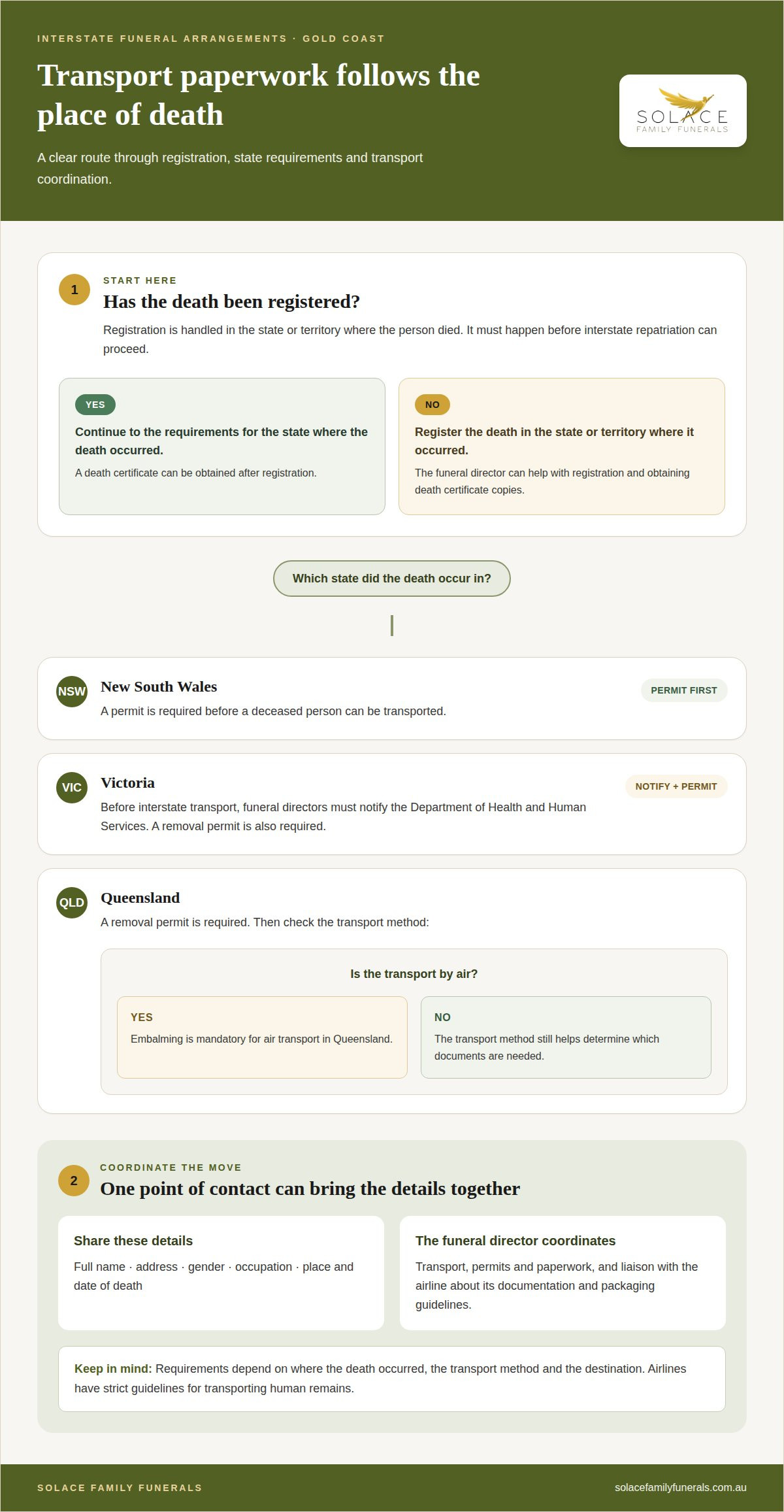
In Australia, register the death with Births, Deaths and Marriages in the state or territory where the person died. For a death in Queensland, registration is handled by Queensland’s Births, Deaths and Marriages. A death certificate can be obtained after registration.
When arrangements involve another state, the funeral director can coordinate transport and documentation. The state where the death occurred, the option chosen and the destination all affect which paperwork is needed.
Funeral director coordination and paperwork
If you’re arranging a funeral from interstate for a Gold Coast service, the funeral director can coordinate transport, permits and paperwork. The place of death and the transport method determine which documents are needed.
Funeral director responsibilities
A funeral director coordinates practical arrangements, transport and paperwork for the funeral. This support is especially helpful when you’re grieving from interstate, as requirements can differ between the state where the person died and Queensland.
For example, New South Wales requires a permit before a deceased person can be transported. In Victoria, funeral directors must notify the Department of Health and Human Services before interstate transport, and a removal permit is required. In Queensland, a removal permit is required, and embalming is mandatory for air transport.
Choosing a funeral director remotely
Gold Coast funeral directors can help families organise services remotely by coordinating transport, documents and funeral details with relatives who live elsewhere. Arranging a funeral from interstate for a Gold Coast service can start with a conversation about the person’s wishes and the family’s priorities.
Airlines have strict guidelines for transporting human remains, so the funeral director liaises with the airline about documentation and packaging. Having one clear point of contact helps relatives stay informed and involved, without requiring everyone to manage separate arrangements while grieving.
Meeting and coordinating with a funeral director
A meeting gives you space to share essential details and discuss the service, transport and paperwork. Useful information includes the deceased person’s full name, address, gender, occupation, and place and date of death.
The funeral director uses these details to coordinate arrangements and explain the relevant documents. The death is registered in the state or territory where the person died, and registration must occur before interstate repatriation can proceed. The funeral director can help with registration and obtaining death certificate copies.
Discuss the preferred service and any wishes the family wants respected. Interstate funeral arrangements can start with a conversation about the details and paperwork involved.
Funeral pricing and disclosure
While you’re grieving, clear pricing can make decisions about a farewell easier to understand. An estimate should explain what each arrangement covers, so you can see how the service, transport and cemetery choices affect the total.
The price depends on the circumstances and is provided after a quote request; key factors include burial or cremation, the service format, interstate transport and cemetery arrangements. For a Gold Coast cemetery burial, the cemetery site cost is included in the funeral director’s invoice. Ask how that site cost appears in the estimate, alongside other selected arrangements.
For cremation, ask whether any government levy is included or excluded from the estimate. This helps you understand the quoted total and identify any additional amount. If you’re considering a chapel service before cremation or a memorial after a private cremation, request a clear breakdown of each arrangement rather than relying on a package label alone.
Funerals Australia members are required to provide an itemised estimate for funeral costs and work within the family’s budget. An itemised estimate helps show which services and arrangements make up the total. If you have a firm budget, sharing it during the pricing discussion can help shape the proposed farewell around your priorities.
Before accepting an estimate, clarify what each line covers, whether transport is included, and how cemetery costs are shown. You can also ask how changes to the service would affect the estimate. For example, a smaller gathering or a later memorial may change the arrangements being priced, so request an updated breakdown before deciding.
A death certificate is a separate document, not a description of the funeral service. Keeping the certificate process distinct from the estimate helps relatives understand which documents relate to registration and which costs relate to funeral arrangements. This gives your family a clearer basis for planning a meaningful goodbye.
Arranging a Gold Coast funeral
Arranging from interstate means balancing family wishes with practical decisions on the Gold Coast. A clear point of contact helps keep relatives involved, especially when travel isn’t possible or a personal detail matters to the person being honoured.
Start by agreeing on the kind of gathering your family wants: a funeral service, a memorial service, or a private farewell followed by a gathering later. Share the person’s wishes and any meaningful customs with the funeral director so they can guide the arrangements. Relatives on the Gold Coast can also communicate local preferences while you take part in decisions from afar.
If you can’t travel to attend, ask whether the family can arrange a livestream and how remote guests will receive access details. If you can be there in person, confirm the service location and timing with the family or funeral director before making travel plans. Arranging reliable transport for arriving relatives through Black Grandeur Chauffeur can also help ease the stress of travelling during an emotional time. Either option can help you take part in saying goodbye.
Flowers, notices and catering can also be coordinated remotely. Decide what the family would like, share wording or preferences with the person coordinating locally, and agree who will approve the final details. For example, a relative on the Gold Coast could confirm a delivery location while interstate family members review a notice before it is submitted.
Keep decisions in one shared message or document, including the preferred service format, names for notices, flower choices and catering requirements. This gives everyone a clear reference and reduces the risk of conflicting instructions. The funeral director can coordinate the funeral arrangements and advise when the family needs to contact the City directly about a Gold Coast cemetery booking.
Compassionate planning doesn’t require every relative to be in the same place. A trusted local contact, clear decisions and regular updates can help your family create a farewell that reflects what matters most.
For support bringing these arrangements together, discuss your Gold Coast funeral arrangements.
Solace Family Funerals: Direct Cremation
Solace Family Funerals can help you choose an arrangement that reflects your family’s wishes while you coordinate a Gold Coast farewell from interstate. Direct Cremation is an unattended option for families who prefer cremation without a formal service. If you’d like to gather with family, a Family Viewing, Full Service Cremation or Full Service Memorial can offer a different way to remember the person.
When you’re ready to discuss the options, share what matters to your family and how you hope to say goodbye. A conversation with Solace Family Funerals can help clarify the next decisions without requiring you to settle every detail at once.
Contact Solace Family Funerals to talk through your arrangements.
Take the next step at your own pace
Choosing burial or cremation doesn’t mean you have to settle every detail of the farewell at once. Start by sharing what matters most to your family, then work through the remaining decisions together. If you’re arranging a funeral from interstate for a Gold Coast service, one clear conversation with Solace Family Funerals can help turn difficult decisions into a manageable plan.
Solace Family Funerals offers Direct Cremation, Family Viewing and Full Service Cremation, giving families different ways to shape arrangements around their preferences. Talk through which option feels right and what you want the farewell to mean. You don’t need to have every answer ready beforehand.
Contact Solace Family Funerals to discuss your family’s needs and the next step. You can take the arrangements one decision at a time, with care for the person you’re remembering and the people sharing this farewell.
Frequently Asked Questions
Burial or cremation?
If the person left instructions, use them to guide the decision; otherwise, the family can choose according to its preferences. Consider what kind of farewell feels appropriate, whether relatives want to gather together, and whether cemetery burial matters to them. These questions can help your family reach a decision that respects the person’s wishes without feeling pressured to choose immediately.
How Is a Deceased Person Transported Interstate?
Interstate transport can be arranged by air or specialised road transport, depending on the circumstances and route. Road transport may be an alternative when air travel isn’t required. The funeral director coordinates arrangements and required paperwork. For air travel, they liaise with the airline about documentation and packaging. Sharing the departure location and Gold Coast destination helps clarify the transport plan.
How much choice do I have when planning a funeral?
You can shape the funeral around the person’s wishes and your family’s preferences, from the type of gathering to personal details. For example, relatives might choose a reading, music or photographs that reflect the person’s life. If family members live in different states, agree on one person to gather suggestions and communicate decisions clearly.
What Is Interstate Repatriation?
Interstate repatriation means transporting a deceased person from the state where they died to another state, often their home state. It requires coordination of transport and the paperwork for the journey. The arrangements for interstate repatriation can depend on where the death occurred.
What do I do when someone dies?
If the death occurs in a hospital or nursing facility, contact a funeral director to discuss arrangements. If someone dies suddenly at home and hasn’t seen a doctor for some time, call paramedics. They will contact police, who determine whether a doctor can organise a cause of death certificate or the Coroner needs to be involved. Keep the deceased person’s details ready for the arrangements.
What happens if a death occurs interstate or overseas?
Contact Solace Family Funerals to discuss bringing the deceased person to the Gold Coast. The funeral director can coordinate transport and paperwork, as well as customs requirements for an overseas journey. Death registration is handled by Births, Deaths and Marriages in the state or territory where the person died. The funeral director can explain the process and expected timeframe for the journey home.


