

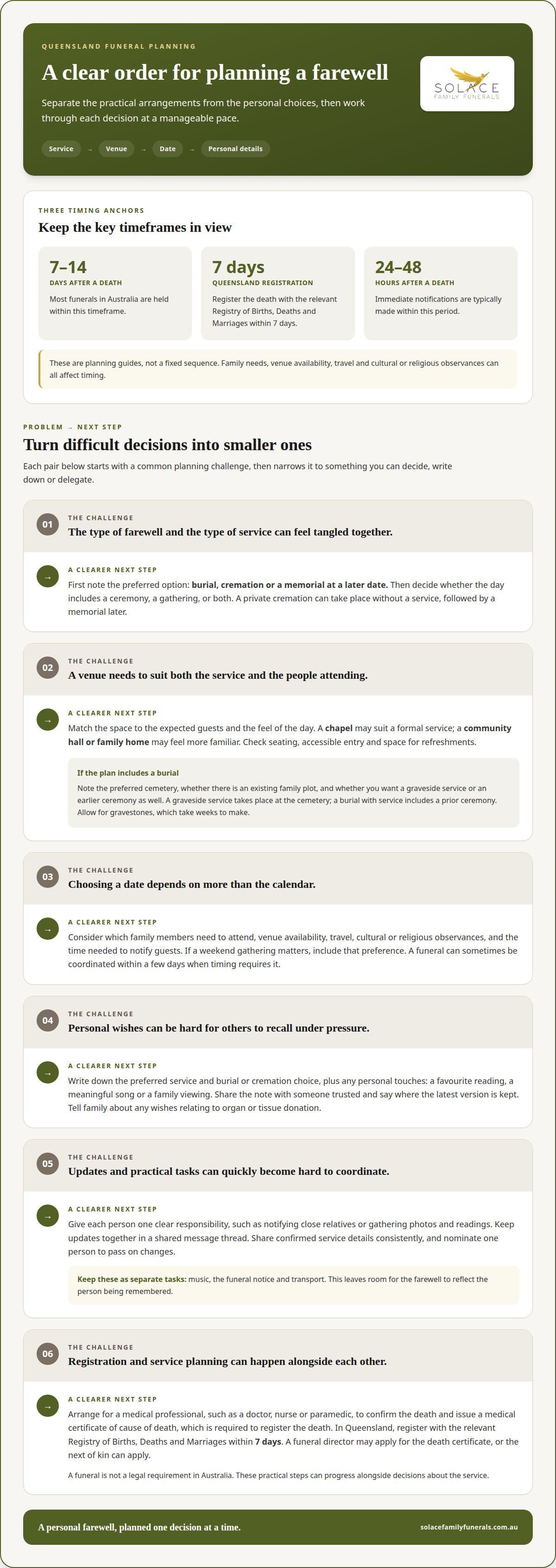
The funeral date is only one part of the plan: most funerals in Australia are held within 7-14 days after a death. A checklist for planning a funeral in Queensland can help you decide on the service, venue and date while keeping important personal details in view. Music, funeral notices and transport also need thoughtful attention.
It’s understandable if these decisions feel like a lot to manage while you’re grieving. You don’t need to settle every detail at once. Working through the arrangements in a clear order can make the next step easier to see.
This guide explains how timing depends on your family’s preferences and practical arrangements, then offers a Queensland funeral-planning checklist for choosing a service and venue, sharing wishes with family, and organising music, notices and transport. Use it to plan a personal farewell while keeping essential details in view.
Key Takeaways
- Most funerals in Australia are held within 7-14 days after a death, so consider family needs and practical arrangements when choosing a date.
- Decide whether a burial will be held at the graveside or include an earlier ceremony, then consider the cemetery arrangements that matter to your family.
- Share funeral wishes with family and friends so they understand the preferred service, venue and personal details.
- Plan music, a funeral notice and transport as separate tasks, leaving space for the farewell to reflect the person being remembered.
Why Use a Funeral Planning Checklist?
A checklist can help separate decisions that are difficult to hold together. Start by noting whether your family is considering burial, cremation or a memorial at a later date. A private cremation can take place without a service, followed by a memorial later. This keeps the choice of ceremony separate from the choice between burial and cremation.
There’s no reliable price comparison here for burial, cremation and direct cremation in Queensland. The total depends on the arrangements chosen, including whether there’s a service, venue or cemetery arrangements. Compare what each option includes, rather than treating the option name alone as a complete cost.
A funeral isn’t a legal requirement in Australia. A medical professional must confirm the death and issue a medical certificate of cause of death, which is required to register the death. These practical steps can happen alongside decisions about burial or cremation.
When someone dies, arrange for a medical professional, such as a doctor, nurse or paramedic, to confirm the death and issue the certificate. Then decide who will coordinate the arrangements and share essential information with close family. You can make decisions about the service as these practical steps progress.
In Queensland, register the death with the relevant Registry of Births, Deaths and Marriages within 7 days. A funeral director may apply for the death certificate, or the next of kin can apply. Keep the certificate application on the checklist alongside registration.
Financial support depends on what is available and your family’s circumstances. Funeral insurance may provide a lump sum on death to help with funeral costs and other expenses. If there is a policy, include its details in the arrangements and take its terms into account.
For a burial, note the preferred cemetery, whether there is an existing family plot, and whether you want a graveside service or an earlier ceremony as well. A graveside service takes place at the cemetery; a burial with service includes a prior ceremony. With cremation, the family can keep or scatter the ashes according to the person’s wishes, or arrange a memorial later. These choices shape the venue, ceremony and follow-up arrangements.
- Write down the preferred option: burial, cremation or a later memorial.
- Note the cemetery and graveside or chapel preference for burial.
- Allow for gravestones, which take weeks to make.
Choosing a funeral service, venue and date
Begin with the kind of farewell your family wants: a ceremony, a memorial gathering, or a private arrangement followed by a gathering later. This choice guides the venue, guest numbers and shape of the day. A chapel may suit a formal service, while a community hall or family home may feel more familiar. Consider seating, accessible entry, space for refreshments, and whether the venue provides multimedia screens or digital signage, such as solutions from oxhoo.com, to present photo tributes and service details.
Choose a date by considering which family members need to attend, your preferred venue and any cultural or religious observances. A funeral can sometimes be coordinated within a few days when timing requires it. Venue availability, travel and the time needed to notify guests all affect the plan. If a weekend gathering matters to your family, include that preference when considering dates.
A funeral director can turn your choices into a workable plan, from the service format to venue arrangements. Explain what you want guests to experience and what would help them remember the person. Ask for a clear breakdown of what the arrangements include and how the venue suits the service. Solace Family Funerals is a local, family-owned funeral home on the Gold Coast, offering personalised support and transparent pricing.
Use this short checklist to narrow the options:
- Service: Decide whether the day includes a ceremony, a gathering, or both.
- Venue: Match the space to expected guests, accessibility and refreshments.
- Date: Consider family travel, venue availability and observances.
- Practical details: Confirm how the coffin will be presented and where guests will gather afterwards.
If you’d value support bringing the service and venue choices together, discuss your funeral arrangements with care and clarity.
Telling family and friends about funeral preferences
Start with a written note naming your preferred service, burial or cremation, and any personal touches. Include details such as a favourite reading, a meaningful song or whether you’d like a family viewing. Share the note with someone you trust and say where the latest version is kept. Clear, accessible preferences can ease decision-making for family and friends.
Talk directly with the people most likely to organise the farewell. In Australia, family members or next of kin may be contacted to provide consent if organ or tissue donation is wished for, so tell your family about those wishes too. A conversation gives them context, while a written record helps prevent important details being missed.
Delegate practical tasks by assigning one responsibility to each person. For example, a family member could notify close relatives while a friend gathers photos or collects readings. Give each person a clear task and a simple way to report progress, such as a shared message thread. Keeping updates together can reduce repeated calls during a demanding time.
Immediate notifications are typically made within the first 24-48 hours after a death. Begin with close family and friends, then ask a trusted person to pass on details to wider circles. Share confirmed service information consistently, including the date, venue and any request about flowers or attendance. If plans change, nominate one person to circulate the update.
A family viewing gives relatives a private opportunity to say goodbye before the funeral. Discuss who wishes to attend and whether a smaller gathering would feel more comfortable. Keep the invitation personal and make clear that attendance is optional. A family member can coordinate arrival times and let guests know what to expect.
- Record preferences in writing: family can refer to clear choices and examples.
- Share donation wishes: next of kin may be asked to provide consent.
- Assign notification tasks: one contact can keep updates consistent.
- Discuss a family viewing: relatives can choose a private farewell that suits them.
Music, funeral notices and transport
Music, notices and transport each involve practical details guests need. Give each one a separate line on your checklist, with the relevant information beside it. This helps coordinate the ceremony and keeps smaller arrangements from being left until the day.
Choose music that reflects the person and the moments in the service. A family favourite might accompany guests arriving, while a meaningful song could close the ceremony. Write down each title, artist and place in the service, then give the list to the person coordinating the music. Include any reading or spoken introduction that should accompany a selection.
For a funeral notice, prepare the person’s name and confirmed service details. Decide whether to place it in a newspaper, share it directly with family and friends, or do both. Keep the wording clear and consistent, and nominate a family contact for questions or changes. This helps guests rely on one version of the arrangements.
Map the journey from the service venue to the cemetery or a later gathering. Note where the procession begins, how the coffin will be transported and how guests can travel between locations. Relatives arriving separately may need clear directions and parking details. Include these instructions with the service information. If wider estate logistics or family travel require moving personal vehicles or machinery, Queensland providers like Done Wright Towing & Transport can help with vehicle transport.
- Music: note the title, artist and moment for each selection.
- Notice: include confirmed details and a nominated contact.
- Transport: set out the procession route and guest directions.
If you’d like help coordinating the service details, talk with us about planning the service.
Solace Family Funerals
Solace Family Funerals can help you turn your preferences into a clear plan for a farewell. If you’re weighing cremation, a family viewing or a memorial, we can talk through the arrangements and help you understand how each option shapes the service. A Full Service Cremation or Full Service Memorial may suit families wanting a gathering, while Direct Cremation is an option without a service at the time.
You don’t need every detail settled before starting a conversation. Bring the choices you’ve made so far, such as your preferred service, venue, music or notice details, and Solace Family Funerals can talk you through the next practical steps.
When you’re ready, contact Solace Family Funerals to talk about your funeral arrangements.
Take the next step at your own pace
Grief can make even a small decision feel significant. You don’t need every part of the farewell settled before talking it through. Start with the choice that feels clearest, whether it’s the kind of gathering you want or a personal detail that would help honour someone’s life.
A checklist for planning a funeral in QLD is a working document, not a set of decisions you must complete all at once. As you plan a funeral in Queensland, add preferences as they become clearer and involve someone you trust if that would help. A calm conversation can turn uncertainty into a manageable next step.
Solace Family Funerals can listen to what matters to you and talk through arrangements with care and clarity. There’s no need to prepare perfect answers before getting in touch. Contact Solace Family Funerals when you’re ready to discuss your plans. You can take it one decision at a time.
Frequently Asked Questions
How Long Does It Take to Organise a Funeral?
Funeral arrangements in Australia commonly take around 7-14 days after a death. On the Gold Coast, the date can depend on family travel, venue coordination and the kind of service planned. Tell the funeral director which relatives need to attend and whether cultural or religious observances affect timing. These details help shape a practical schedule.
How soon must a funeral be held in Queensland?
There’s no legal requirement to hold a funeral in Australia, so Queensland families don’t face a compulsory funeral deadline. If you choose a service, the date can reflect family preferences, venue arrangements and cemetery availability. You can also choose cremation without a ceremony and hold a memorial later, at a time that suits your family.
What is a funeral checklist for planning a service in Queensland?
A checklist is a practical record of decisions and responsibilities, not a form you must complete in a particular order. Note the preferred service, who is coordinating arrangements and which relatives need updates. Add details such as readings, photo contributions, accessibility needs and who will handle enquiries. Keeping these notes together helps family members stay aligned.
How do you arrange a funeral if the deceased had no funeral plan or cannot afford one?
You can arrange a funeral without a prepaid plan by deciding what matters most and discussing those choices with a funeral director. Direct Cremation is an option without a formal service; you can consider a separate memorial later. If costs are a concern, explain your priorities before agreeing to arrangements and ask about any relevant insurance or assistance.
What should you know about Queensland cemetery, crematorium and regional funeral arrangements?
Cemetery arrangements depend on the chosen cemetery, including available options and applicable fees. For Gold Coast families, Solace Family Funerals coordinates cremations at Eco Memorial Park Crematorium and Logan City Crematorium, unless alternative arrangements are requested. Burial plot and cemetery fees are not included in package prices and vary by cemetery. Families travelling from elsewhere in Queensland may also need to plan for travel distances, the venue and coordination between locations.
What are the legal requirements for burial or cremation in Queensland?
A medical professional must confirm the death and issue a medical certificate of cause of death, which is required to register the death. In Queensland, register the death with the relevant Registry of Births, Deaths and Marriages within 7 days; having a funeral is not legally required.


