
A casket isn’t needed to give a memorial a clear centre. Memorial service ideas without the body can start with one focal point, such as a table of photographs and flowers, alongside one or two personal items that bring the person to mind. Shared memories, readings and music can help honour their life.
It’s understandable if planning feels uncertain when the familiar parts of a funeral aren’t there. A simple, thoughtfully chosen focal point can help guests feel connected, while a clear order gives the service a gentle shape without making it feel formal or impersonal.
This guide explains how to create a focal point, plan the order of service and include familiar funeral elements in a way that feels right for your family. It also offers ideas for a closing gesture, so the gathering can end with a moment of meaning and care.
Key Takeaways
- Work with a funeral professional to choose a setting and create a single, personal focal point without a casket.
- Give the gathering a gentle shape with a clear order, balancing tributes, music and time for shared memories.
- Keep familiar funeral elements that feel meaningful to your family, and adapt them to suit the person being remembered.
- Choose a closing act that offers guests a simple way to honour the person and mark the end of the gathering.
How can a funeral professional help create a focal point without a casket?
A funeral director can help you choose a venue, create a symbolic centrepiece and plan a respectful goodbye. You can include ashes, photographs or keepsakes if they suit your family and the venue. Guests who can’t attend in person may contribute a recorded audio or video tribute.
-
Choose a memorial venue with help from a funeral professional
Tell the funeral professional what atmosphere you want, then consider a community hall, garden or family home instead of a crematorium. The best fit depends on guest needs, access, privacy and whether the setting suits the planned ceremony.
Ask the professional to consider how the room can be arranged for a photograph display, eulogy and shared goodbye. They can help you choose when to hold the gathering, too. Families may hold a memorial weeks or months after a death, or arrange two gatherings at different times.
Before choosing a venue, make sure it can accommodate the guests and the planned format. A quiet room may suit a small gathering, while a larger hall can provide space for shared memories and a meal.
-
Choose a symbolic focal point with guidance from a funeral professional
Choose one meaningful centrepiece with the funeral professional, such as a framed photograph surrounded by flowers. A single focal point gives guests somewhere to direct their attention without trying to recreate a casket display.
Add one or two personal items that reflect the person’s life, such as a favourite book, musical instrument or gardening gloves. Choose recognisable items that can be placed safely, and avoid crowding the table or competing with the photograph.
Think about how the focal point connects to the eulogy and the person you’re honouring. A well-loved recipe book, for example, could prompt a memory about family meals and give guests a natural opening to share stories.
-
Plan for ashes, keepsakes and online participation with help from a funeral professional
Decide with the funeral professional whether ashes will be present, displayed or simply acknowledged in the ceremony. The choice can reflect your wishes and the venue’s arrangements, without making ashes the centre of every tribute.
Gather photographs and keepsakes for a small display, choosing items that invite memories rather than crowd the space. Some families also choose to include lasting commemorative pieces, such as memorial diamonds created from ashes or hair by diamondcremations.com. If someone can’t attend, you could include a recorded audio or video tribute alongside the eulogy or readings.
Plan the order of tributes and how any recorded contributions will be played. This can help the service feel connected for guests in the room and those contributing remotely, while keeping the focal point clear.
What should the order of service include?
In Australia, a memorial service’s cost depends on the venue, service choices and arrangements, with the price given after a quote request. A funeral professional can help shape the sequence, coordinate tributes and timing, then organise the practical details around your family’s situation.
-
Arrange the order of service with a funeral professional
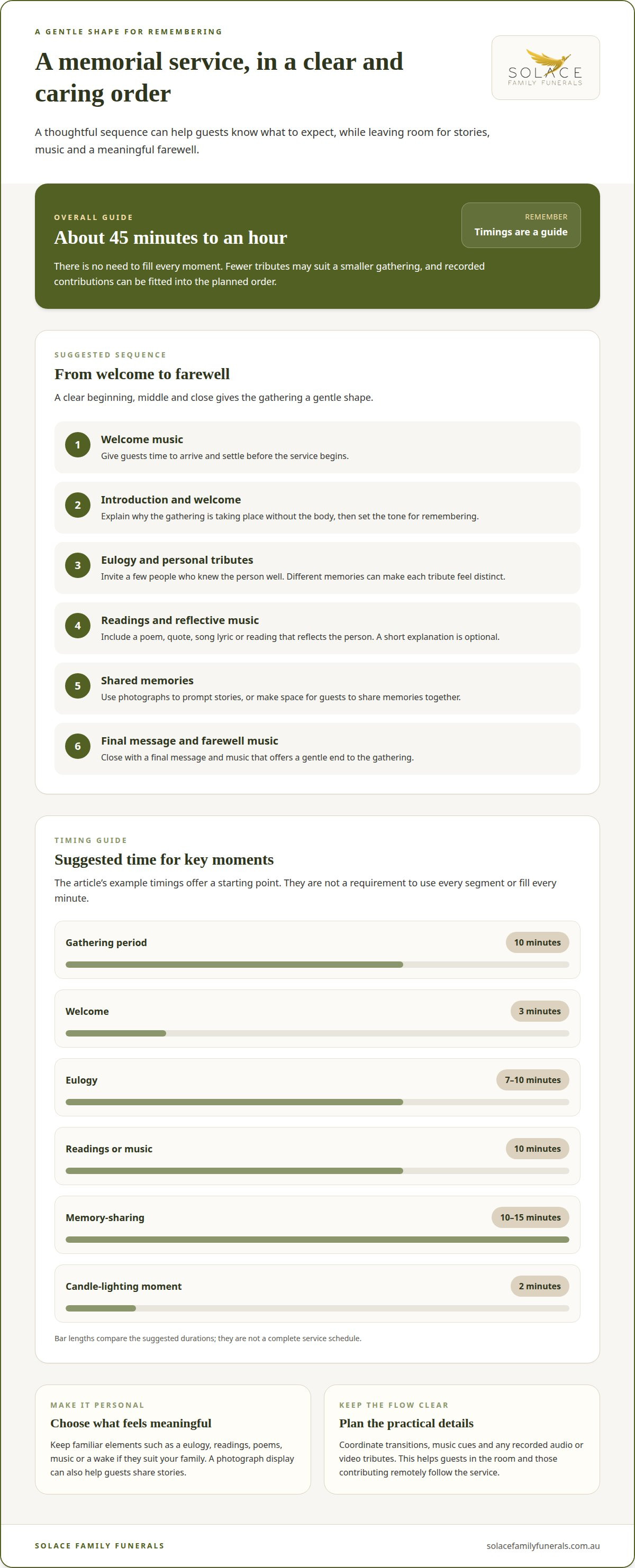
Plan a sequence with a clear beginning, middle and close. A memorial service might include welcome music, an introduction, a eulogy, tributes, reflective music, a final message and farewell music. Since there’s no casket present, explain at the beginning why the gathering is taking place without the body.
Invite a few people who knew the person well to give tributes, with each focusing on a different memory. Guests might also share a poem, quote or song lyric that reflects the person, with a brief explanation if they wish. For a more conversational ceremony, use photographs to prompt shared stories rather than a series of formal speeches.
-
Set the service timing with help from a funeral professional
Agree on the overall length and each segment with the professional, allowing room for people to arrive and settle. A suggested memorial service runs about 45 minutes to an hour, including a 10-minute gathering period, a 3-minute welcome and a 7-10-minute eulogy.
Allow 10 minutes for readings or music, then 10-15 minutes for memory-sharing. A 2-minute candle-lighting moment can offer a quiet pause. These timings are guides, not a requirement to fill every moment; fewer tributes may suit a smaller gathering, while recorded contributions can be fitted into the planned order.
Ask the funeral professional to coordinate transitions, music cues and any audio or video tributes. This keeps the sequence manageable and helps guests understand what comes next. To discuss arranging a memorial service, consider how the order can reflect your family’s needs.
Traditional funeral elements at a memorial service
- Keep familiar ceremony elements that suit your family. A funeral without a body can still include a eulogy, readings, poems, music and a wake. Choose elements that reflect the person, rather than trying to recreate every part of a traditional funeral. For example, three pieces of music can mark the beginning, a reflective moment and the close. A religious reading may be meaningful, or you may prefer secular words.
- Shape the gathering around the reason for remembering. Families may hold a memorial when remains haven’t been recovered, or while a traditional funeral process continues. A celebration of life can also take place separately, giving people space to gather when they’re ready. The gathering itself doesn’t change the legal process when someone is presumed dead. Keep the ceremony focused on honouring the person and supporting those present.
- Prepare an obituary that reflects the person’s life. You can write an obituary without a funeral home by gathering accurate details from family members and close friends. Include the person’s name, the qualities people remember, and examples such as their role as a parent, community member or friend. Add service details only if they’re settled, and ask someone who knew them well to review the wording before sharing it.
- Choose how to share a funeral notice or tribute. A notice can invite people to a memorial, while a newspaper tribute can honour someone who can’t attend a gathering. Include the service location, whether it’s a church or another venue, and any request about flowers or contributions if relevant. A memorial can be held in different settings, so choose wording that clearly explains where guests should go and what kind of celebration to expect.
Closing acts in place of a committal
- Choose one closing gesture that reflects the person. Without a committal, a shared action can give the ceremony a clear ending. Invite guests to place a flower beside a photograph, write a memory card or pause together for a favourite song. Choose one gesture rather than several, so the moment feels considered and guests know how to take part.
- Set aside time for a final message. Ask a family member or celebrant to offer closing words, with two minutes as a suggested guide. They might thank friends for gathering, name a quality the family will carry forward, and explain what happens next. Keep the wording plain and personal; a short message can feel more natural than a formal speech.
- Plan the closing act and its timing. Allow about five minutes for the suggested closing act, such as guests placing flowers or sharing a final reading. A funeral professional can coordinate the music, explain the gesture before it begins, and help the group move through it without confusion. Avoid an activity that requires guests to queue or handle personal items unexpectedly.
- Decide where friends and family can gather afterwards. A quiet garden, reception area or nearby meeting place can give guests room to stay together after the ceremony. Let attendees know whether they can remain for conversation, share refreshments or leave when ready. If the closing involves candles, flowers or memory cards, plan how those items will be gathered and kept afterwards.
If you’d like support shaping a respectful ending, talk with Solace Family Funerals about your memorial arrangements.
Solace Family Funerals: Full Service Memorial
Solace Family Funerals offers a Full Service Memorial for families planning a gathering without the body present. If you’d like professional support turning your ideas into a service, this can help bring the venue, tributes and closing act together in a way that reflects the person you’re remembering.
Share what matters to your family, such as the tone you want, meaningful music or readings, and whether you’d like photographs or keepsakes included. Solace Family Funerals can help organise the memorial around those choices. Other options include burial with service, direct cremation and family viewing.
Contact Solace Family Funerals to talk about planning a memorial service.
Let the next step reflect what feels right
You don’t need to settle every detail at once. Begin with the feeling you want people to carry from the gathering, then let that guide the choices ahead. Memorial service ideas without the body can honour someone without pretending the loss is simple or complete.
If you’re considering arrangements before or around the memorial, Solace Family Funerals also offers Direct Cremation, Family Viewing and Full Service Cremation, which includes a gathering before cremation. These options can help you consider the arrangements alongside the kind of gathering your family wants.
When you’re ready to talk through the next step, contact Solace Family Funerals. You can take the planning one decision at a time, with room to make the service personal to your family.
Frequently Asked Questions
What about religious or cultural expectations?
Make space for the customs that matter to your family while keeping the service comfortable for everyone attending. A family representative or religious leader can help identify meaningful prayers, language, dress or rituals. For example, agree beforehand whether guests will join in a response or observe quietly. Clear guidance helps people take part respectfully without feeling unsure.
What is a memorial service without remains?
A memorial service is a gathering to remember and honour someone when their body or ashes aren’t present. It can bring family and friends together for words, music, cultural practices or quiet reflection. Relatives who live far apart, for example, might meet at a later date when they’re able to travel and share memories in person.
Where can I find help putting it all together?
Solace Family Funerals can help bring your memorial arrangements together through its Full Service Memorial. To make the first conversation useful, have a sense of who you hope will attend, any cultural or religious wishes, and what kind of setting feels appropriate. Call 0422 510 105 to discuss your arrangements with the team.
What is a memorial service without the body called in Australia?
In Australia, it’s generally called a memorial service or memorial ceremony. Some families describe a less formal gathering as a celebration of life. The name can help set expectations in an invitation, but explain clearly that the person’s body won’t be present so guests understand the purpose before they arrive.
How is a memorial service different from a funeral or celebration of life?
A funeral often centres on a formal farewell and may include the person’s body, while a memorial service is usually held without it. A celebration of life often places greater emphasis on the person’s interests, character and happy memories. These forms can overlap, so choose wording and a tone that reflect your family’s beliefs and preferences.
What are meaningful memorial service ideas without a body present?
Choose a simple activity that lets guests contribute in their own way. For example, invite each person to write a short memory on a card, then collect the cards for the family to read later. You could also display a map marked with places important to the person, such as a childhood town or favourite walking route, and invite guests to add a memory.


