
Centrelink may provide a bereavement payment to an eligible surviving partner, but it is separate from Queensland’s Funeral Assistance Scheme. The state scheme may arrange a funeral when someone dies in Queensland and has no known next of kin willing or able to pay; costs may later be recovered from the estate or an eligible applicant. These are the key distinctions to understand when seeking funeral assistance for pensioners in QLD.
It’s understandable to look to Centrelink when funeral costs add to an already difficult time. A bereavement payment may provide financial support, but it isn’t automatically a contribution towards the funeral bill, and eligibility depends on the circumstances.
This guide explains what Centrelink may pay, who can apply for Queensland funeral assistance, how financial circumstances can affect an application and where to lodge it. You’ll also find the practical difference between a bereavement payment and assistance arranged through the state, so you can consider the next step with greater clarity.
Key Takeaways
- Centrelink bereavement payments may help an eligible surviving partner, but they aren’t automatically a contribution towards funeral costs. For the lump sum described, both partners must have received an income support payment or pension for at least 12 months before the death.
- Before signing a funeral services contract, understand how it can affect an individual application to Queensland’s Funeral Assistance Scheme: an application is automatically declined if a contract has already been signed.
- Individual applications for Queensland funeral assistance must be lodged over the counter at a Magistrates Court. Agencies can submit applications by email.
- State funeral assistance isn’t a grant: the scheme may recover the full cost from the deceased’s estate or an eligible spouse or parent applicant.
Eligibility requiring 12 months on an income support payment or pension
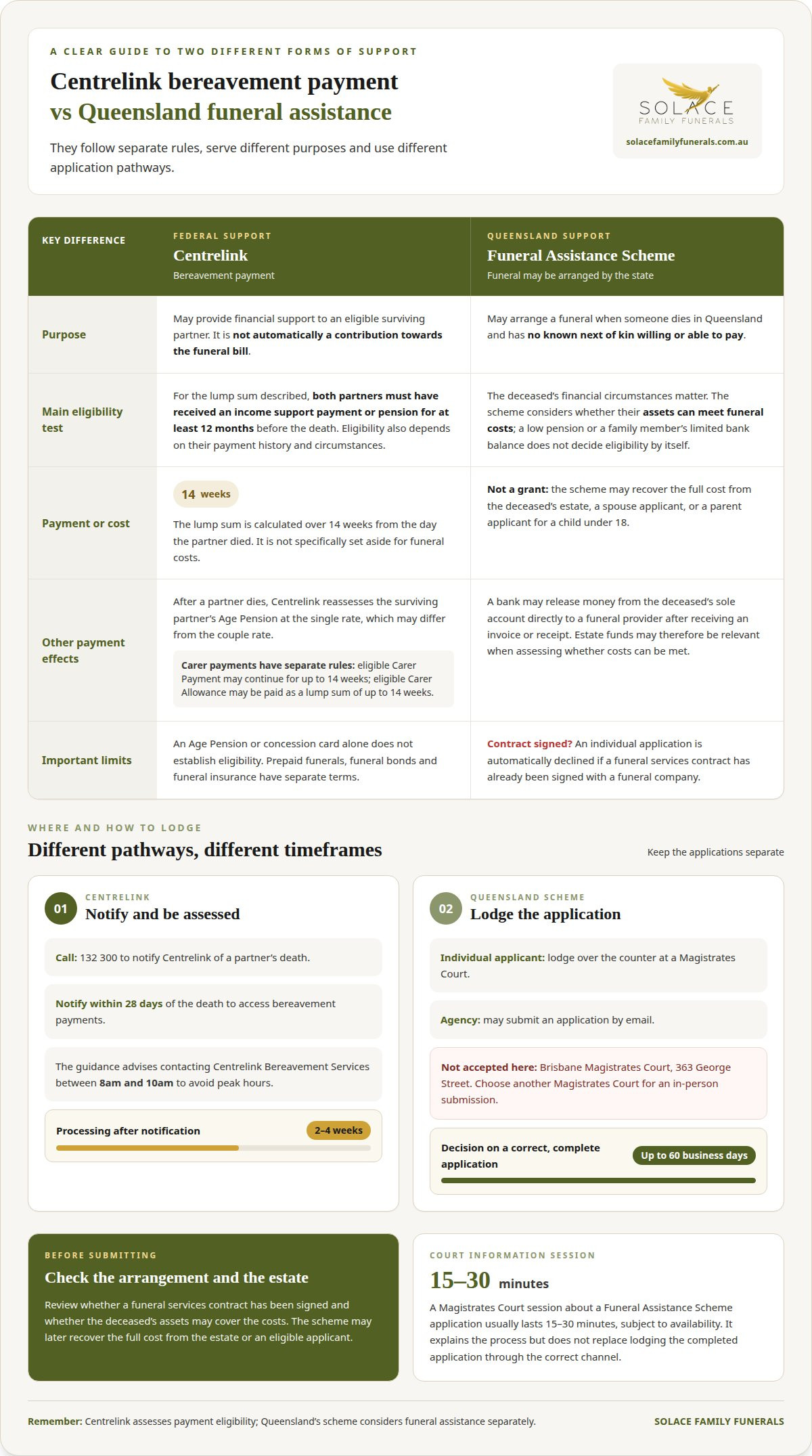
For the Centrelink lump sum bereavement payment described here, both partners must have received an income support payment or pension for at least 12 months before the death. This may include a couple where one partner received the Age Pension. The payment is calculated over 14 weeks from the day their partner died, and eligibility depends on the couple’s payment history and circumstances.
After a partner dies, Centrelink reassesses the surviving partner’s Age Pension at the single rate. The amount may change because the single rate differs from the couple rate. A person's regular pension payments may change after a death. A single person receiving an allowance is paid up to the day before their death.
Carer payments follow separate rules. An eligible Carer Payment recipient may continue receiving it for up to 14 weeks after the cared-for person’s death. An eligible Carer Allowance recipient may receive a lump sum of up to 14 weeks of Carer Allowance. These payments go to the carer and aren’t specifically set aside for funeral costs.
Prepaid funerals, funeral bonds and funeral insurance have different terms. Whether they suit a Queensland pensioner depends on their finances and preferences. These options are separate from the Centrelink bereavement payment described above.
Centrelink doesn’t arrange funerals. Queensland’s Funeral Assistance Scheme may arrange one when someone dies in Queensland and has no known next of kin willing or able to pay.
An Age Pension or concession card doesn’t by itself establish eligibility for the Centrelink bereavement payment. For families seeking funeral assistance for pensioners in QLD, the relevant Centrelink test includes the partners’ payment history, not simply whether someone holds a card.
Local council or charity support is separate from Centrelink. Don’t assume a council or charity payment will cover funeral costs. Eligibility for funeral assistance for pensioners in QLD through the state scheme is considered separately from Centrelink payments.
Financial circumstances that can lead to an application being declined
For Queensland funeral assistance, an important financial question is whether the deceased person’s assets can cover funeral costs. If they can, the circumstances may not meet the scheme’s financial basis for assistance. A low pension or limited money in a family member’s bank account doesn’t, by itself, determine whether an application qualifies.
Understand this application rule before making funeral arrangements: an individual application is automatically declined if a funeral services contract has already been signed with a funeral company. The timing of an agreement matters. Don’t treat an application as a way to recover costs after signing a contract.
Funds in the deceased person’s estate may affect what happens next. A bank may release money from the deceased’s sole account directly to a funeral provider after receiving an invoice or receipt. An account balance could therefore be relevant when considering whether the estate can meet funeral costs, even if the family has limited funds available.
Queensland’s scheme may recover the full cost of funeral services from the deceased’s estate, a spouse applicant, or a parent applicant for a child under 18. Assistance is therefore not simply a payment that removes costs. The estate and the applicant’s relationship to the deceased can matter when the Department considers recovery.
If a Queensland pensioner dies with unpaid debts or no funeral plan, those facts alone don’t determine whether assistance will be approved. The key financial issue is whether the deceased’s assets can cover funeral costs; any scheme assistance may later be recovered from the estate or an eligible applicant. Review the estate and any signed funeral arrangements before submitting an individual application, as grief can bring practical decisions alongside loss.
Where and how to lodge an application
For Queensland’s Funeral Assistance Scheme, an individual applicant must lodge the application over the counter at a Magistrates Court. An agency may submit an application by email instead. The Brisbane Magistrates Court at 363 George Street cannot accept these applications, so choose another Magistrates Court for an in-person submission.
Before lodging, complete the application and provide the information it requests about the deceased, the applicant and their financial circumstances. The decision considers whether the deceased’s assets can meet the funeral service costs. Correct and complete applications can take up to 60 business days from receipt to decision, so allow for that period when planning next steps.
A Magistrates Court information session about a Funeral Assistance Scheme application usually lasts 15-30 minutes, subject to availability. It can help explain the application process before you submit it. This is separate from the government’s decision and does not replace lodging the completed application through the correct channel.
Centrelink bereavement payments follow a different process from Queensland funeral assistance. To notify Centrelink of a partner’s death, call 132 300. The guidance advises contacting Centrelink Bereavement Services between 8am and 10am to avoid peak hours. Notify Centrelink within 28 days of the death to access bereavement payments; processing typically takes 2-4 weeks after notification.
Keep the two pathways distinct: Centrelink assesses payment eligibility, including income support history, while the Queensland scheme considers applications for funeral assistance. A Centrelink payment is not the same as a state-arranged funeral. To apply for the state scheme, lodge in person at an eligible Magistrates Court. An agency can submit its application by email.
Does the Queensland Government provide a funeral or burial payment?
Queensland’s Funeral Assistance Scheme may arrange a funeral for someone who dies in Queensland and has no known next of kin willing or able to pay. A person may also be eligible if they cannot afford a funeral for a friend or relative, and that person’s assets won’t cover the costs. The scheme operates under the Burials Assistance Act 1965.
This is not a grant. The Queensland Government may require repayment through a payment plan with the Department of Justice and Attorney-General. It may seek the full cost from the deceased person’s estate, a spouse applicant, or a parent applicant for a child under 18. Before applying, consider both whether the estate can pay and who may be responsible for repayment.
The scheme has practical limits. Cremation is the default unless burial is requested on the application form. Its funeral services don’t include issuing the official death certificate. If cremated ashes remain unclaimed, they’re stored for a maximum of 12 months. Burial arrangements may allow up to four deceased people to be interred together in one plot.
For a deceased child under 18, the scheme defines a parent as next of kin. Its coffin provision says it must accommodate a larger person, usually someone over 150kg, or as required. These details help explain what the scheme may arrange, but assistance isn’t an unrestricted cash payment for families to choose any funeral arrangements.
If you’re considering a private funeral service rather than a state-arranged funeral, talk through burial arrangements and the service that best reflects your wishes. The distinction matters: Queensland’s scheme may arrange and later recover costs, while a private arrangement is organised separately by the family.
Solace Family Funerals
Solace Family Funerals can help you consider a private funeral arrangement once you understand the government assistance options. If you’re weighing a simple cremation against a gathering for family and friends, options include Direct Cremation, Family Viewing, Full Service Cremation and Full Service Memorial.
These services are separate from Queensland’s Funeral Assistance Scheme, which may arrange a funeral in specific circumstances and can recover costs. Solace Family Funerals can help you discuss the farewell you want and the practical arrangements involved, so you can make decisions with a clearer understanding of your options.
If you’d like to talk through a funeral arrangement, contact Solace Family Funerals.
Take the next step at your own pace
After a death, practical decisions can arise before you feel ready to make them. Give yourself room to separate questions about financial assistance from decisions about the farewell. If you’re seeking funeral assistance for pensioners in Queensland, keep the application pathway and funeral arrangements distinct so you can consider each clearly.
You don’t need to settle every detail at once. A conversation about the kind of service that feels right can break a difficult decision into manageable choices, while allowing space for family wishes and personal circumstances. Solace Family Funerals can discuss the arrangements with you with care and transparency.
When you’re ready, contact Solace Family Funerals to discuss what you need. Take the next step when it feels right for you.
Frequently Asked Questions
Does Centrelink help with funeral costs?
Centrelink may pay a bereavement payment to an eligible surviving partner, but it isn’t a dedicated contribution towards the funeral bill. The lump sum is based on the difference between the couple’s combined payment and the single rate after the death. If you’re helping a relative, keep this payment separate from funeral invoices and establish who will organise and pay for the arrangements.
How do I know if I’m eligible to apply?
For Queensland’s Funeral Assistance Scheme, the key issue is whether the deceased’s assets can meet funeral costs. You may be eligible if you cannot afford a funeral for a friend or relative who died in Queensland and their assets won’t cover it. This is separate from Centrelink bereavement payment eligibility, which considers the partners’ income support or pension history.
What types of Centrelink funeral assistance are available?
Centrelink doesn’t arrange a funeral or offer a general funeral-cost grant. Depending on the circumstances, support may include a lump-sum bereavement payment for an eligible surviving partner, continued Carer Payment or Carer Allowance after a death, or Family Tax Benefit support after a child’s death. These payments have different eligibility rules, and they aren’t all contributions towards funeral expenses.
Will I need to pay the Department back?
Queensland Funeral Assistance Scheme support isn’t a grant, and the Department of Justice and Attorney-General may recover the full funeral cost. Recovery may be sought from the deceased’s estate, a spouse applicant, or a parent applicant for a child under 18. If assistance is arranged, ask how repayment will be handled, including the payment plan, before making financial decisions.
What funeral assistance is available to pensioners in Queensland?
Queensland pensioners may be able to apply for the state scheme when a friend or relative dies in Queensland, they cannot afford the funeral, and the deceased’s assets won’t cover it. The scheme arranges funeral services rather than providing unrestricted cash. Cremation is the default; burial must be requested on the application form.
How can families apply for funeral assistance in Queensland, and what documents are required?
An individual must lodge an application over the counter at a Magistrates Court; agencies may submit by email. The Brisbane Magistrates Court at 363 George Street cannot accept applications. Complete the form and provide the details it requests; correct and complete applications can take up to 60 business days for a decision. The scheme doesn’t issue the official death certificate.


