
What if a farewell without a church could still feel deeply personal, comforting and complete? A funeral service without a church can take place in a setting that feels right for your family, with meaningful words and rituals shaped around the person you’re remembering.
It’s understandable to wonder where to begin, who can lead the service and whether choosing a non-church venue means leaving faith out altogether. It doesn’t have to. A church-free service may include religious readings or prayers, or it can be entirely non-religious. The important thing is that the farewell reflects your wishes and gives people space to remember.
This guide walks you through service formats, venues and ceremony elements, one step at a time. You’ll also learn how a Gold Coast funeral director can help bring the arrangements together. Solace Family Funerals can arrange a full-service cremation at a chosen venue or a memorial ceremony with flexible location and timing, so you don’t have to manage every detail alone.
Key Takeaways
- A funeral service without a church is about the venue, not necessarily the beliefs or traditions included in the ceremony.
- Compare a chapel, chosen venue or graveside setting by the atmosphere you want and what will feel comfortable for guests.
- A simple ceremony outline offers gentle structure while leaving room to adapt or omit any element.
- Take decisions one step at a time, beginning with the wishes that matter most to your family.
- Solace Family Funerals can help Gold Coast families arrange a full-service cremation at a chosen venue or a memorial ceremony with flexible location and timing.
What Does a Funeral Service Without a Church Mean?
Families sometimes want a farewell shaped around the person they knew, rather than expectations about where a service should be held. A funeral service without a church simply takes place somewhere other than a church. Depending on the service format and what feels fitting, the venue might be a funeral chapel, a family-chosen setting or a graveside.
Choosing a different venue doesn’t determine what the ceremony says or believes. A service can include religious traditions, be non-religious or bring together elements that matter to the family. Care, remembrance and the chance to gather are what give a farewell meaning, not the building where it takes place.
Does a funeral without a church have to be non-religious?
No. The location and the ceremony’s beliefs are separate choices. If faith is important to the person being remembered or to the family, you might include a prayer, a religious reading or a moment of reflection. Others may prefer secular readings, music or personal tributes. There’s no single template, and it’s best not to assume what someone would have wanted based only on the venue.
If you’re unsure, start with what you know: a conversation the person had, a tradition they valued or the kind of gathering that would feel comfortable to those closest to them. You can include one faith-based element without making the whole service religious, or keep the ceremony entirely non-religious. Let the person’s wishes and your family’s priorities guide the choices.
What might a church-free farewell look like?
It could be a funeral service at a chapel or chosen venue, or a gathering at the graveside. A funeral service brings people together for a ceremony connected with the person’s funeral arrangements. A memorial is a separate way to remember someone, held without the casket present. Families may choose a memorial after cremation, with or without the ashes present, according to the ceremony they want.
The format influences the feel of the occasion. A chapel may offer a familiar, structured setting, while a chosen venue can make the gathering feel more personal. A graveside service places the farewell at the burial. The general Funeral overview also describes how services and memorials can take different forms.
If you’re considering a gathering after cremation, the Gold Coast memorial service planning guide explores the choices involved. You don’t need to settle every detail at once. Begin with the kind of farewell that feels true to the person, then consider which setting and ceremony elements could bring that feeling to life.
Choose a Gold Coast Venue and Service Format That Feels Right
Once you have a sense of the farewell you want, the setting can help bring it to life. A chapel offers a focused space for people to gather. A chosen venue can have a personal connection, while a graveside service places the ceremony at the burial location. Each creates a different atmosphere, so start with what would feel comfortable for your family rather than searching for a perfect setting.
Practical needs matter, too. Consider how easily guests can reach the venue, whether the space offers enough privacy and how comfortable it will be for older relatives or people with mobility needs. Think about the number of people you expect and whether you’d prefer an intimate gathering or room for a wider circle. A Gold Coast funeral director can help coordinate the venue and service arrangements around the ceremony you have in mind.
It can help to weigh up a few questions together:
- Will the setting feel calm and comfortable for the people attending?
- Does it suit the size and style of gathering you hope to have?
- Does the service format fit the venue and your family’s wishes?
Different settings suit different ceremonies. Solace Family Funerals arranges full-service cremations at a chosen venue, bringing the location and ceremony together in a considered way.
How do you choose a venue for a church-free funeral?
Focus on the experience you want guests to have. A chapel may feel settled and traditional; a chosen venue may have a personal connection; and a graveside setting may suit a farewell centred on burial. Compare access, privacy, guest numbers and the tone you hope to create. A funeral director can coordinate the venue and service arrangements around those priorities.
Funeral service or memorial ceremony: which format suits your family?
A full-service cremation brings the funeral ceremony and cremation arrangements together. A memorial ceremony can be held without the casket present, including after cremation. This gives family and friends flexibility around when and where they gather, which can help if people need time to travel or come together later.
Rather than choosing based on what other families have done, consider whether you want a ceremony connected with the funeral arrangements or a separate occasion focused on remembrance. Solace memorial ceremonies offer flexibility in location and timing. For more on the choices involved, see this guide to memorial services without a casket.
Solace Family Funerals helps families discuss venue and format options for a fitting farewell on the Gold Coast.
Personalise the Ceremony Without Losing Its Gentle Structure
Planning a farewell while grieving can make even small decisions feel heavy. A simple structure can ease some of that pressure, giving the gathering a clear beginning, middle and end without making it feel formal or impersonal. For a funeral service without a church, shape the ceremony around the person and the people who wish to remember them.
A gentle framework might include:
- A welcome: A few words to greet those gathered and explain the purpose of the occasion.
- Personal tributes: Family or friends can share memories, or one person can speak on their behalf.
- Readings or music: Choose words, songs or a quiet moment that feel connected to the person.
- A closing: End with a farewell, a moment of reflection or another fitting gesture.
This is a guide, not a formula. Shorten the service, change the order or leave out anything that doesn’t feel right. A photograph, a favourite piece of music or a memory shared by a close friend may say more than a long programme. Religious elements can sit alongside personal tributes if they matter to your family, but they don’t need to be included if they don’t.
Who can lead a funeral service outside a church?
Your family might choose a celebrant, a relative or another suitable speaker to guide the ceremony. The person leading doesn’t need to make the service elaborate. Their role is to welcome people, introduce each part clearly and help transitions feel calm, especially if several people are speaking. A family member may prefer to contribute a tribute rather than lead the whole service, and that’s a meaningful choice too.
Which readings, music and tributes can make it personal?
Think about what reflects the person’s relationships, values or everyday life. A reading might be a poem, a passage of faith or words written by someone close to them. Music could be a much-loved song or something that brings a particular memory to mind. There’s no need to fill every pause; a quiet moment gives guests room to reflect.
You might invite a few people to speak, or ask one person to gather memories and read them aloud. Photographs can help tell a story, while a shared moment of silence can offer a gentle close. Choose what feels sincere rather than adding elements because they’re expected. For more ideas beyond familiar formats, explore these meaningful alternatives to a traditional funeral.
If decisions feel difficult, begin with one question: what would help those gathered feel connected to the person they’re remembering? Let the answer guide the words, music and small details, while leaving space for a simple ceremony.
How to Plan a Funeral Service Without a Church, Step by Step
Grief can make every decision feel urgent, even when some choices can wait. Planning a funeral service without a church becomes more manageable when you work through the essentials in order, rather than trying to settle the whole ceremony at once.
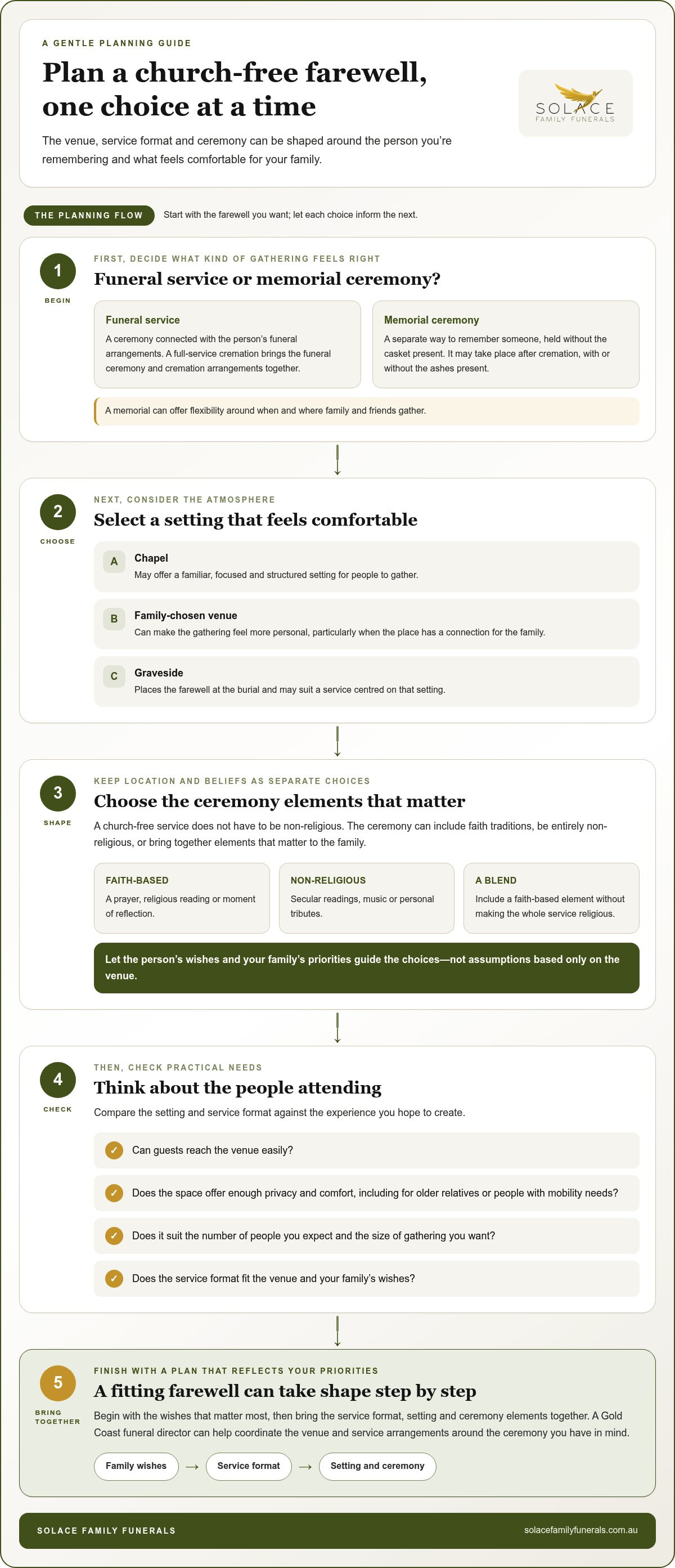
Recommended order: clarify the person’s wishes, choose the service format, consider a suitable venue, then shape the ceremony. Pause between steps if you need to, and focus first on what matters most to your family.
- Clarify wishes and priorities. Begin with anything you know about the person’s preferences, such as religious content, burial or cremation, or the kind of setting they valued. If you don’t know their wishes, make a thoughtful decision based on what feels true to their life and your family.
- Select a format. Consider whether you want a full-service cremation or a memorial ceremony after cremation. The format establishes what kind of gathering you’re planning and which arrangements need to come together.
- Consider a venue. Think about the atmosphere, guests’ needs and setting that best suit the format. Weigh up a chapel, a chosen venue or a graveside service without having to decide every ceremony detail at the same time.
- Shape the ceremony. Once the main arrangements are taking form, decide who will lead, which tributes or readings to include and how you’d like to close the gathering.
Start with the person’s wishes and your family’s priorities
If preferences were shared, use them as a guide, not a source of pressure. Begin by discussing whether faith should be part of the ceremony and whether burial or cremation feels right. If those wishes aren’t known, a caring decision made together is still a meaningful way to honour the person.
Keep the first conversation small. Identify what needs attention now, such as the broad service format, and leave choices like music or readings for later. Family members may have different views, so focus on shared priorities and take one decision at a time.
Coordinate the venue, ceremony and practical details
A funeral director can bring the chosen venue and service arrangements together and coordinate arrangements for a celebrant. A celebrant can help shape the ceremony around your family’s wishes, including its order, words and transitions. You don’t need to arrive with a finished plan; a few preferences are a helpful starting point.
If your family is considering a memorial after direct cremation, the timing allows space to arrange a separate gathering. This guide to arranging a memorial after direct cremation explains that sequence in more detail.
Solace Family Funerals is locally family-owned on the Gold Coast and can help bring your arrangements together. Learn about planning a church-free farewell with Solace.
How Solace Family Funerals Supports a Church-Free Farewell
Making arrangements while grieving can leave you unsure which decision to tackle first. Solace Family Funerals is locally family-owned and operated on the Gold Coast. We can help you work through the choices, from the service format to the ceremony arrangements. A church-free farewell doesn’t need to follow a set template. We’ll listen to what matters to your family and help organise a service that reflects those wishes.
Our support includes bringing practical arrangements together and coordinating celebrant arrangements. Share the preferences you already know, or begin with the questions you’re facing. Clear communication helps you understand the choices in front of you without feeling pushed to settle every detail at once.
What support can a Gold Coast funeral director provide?
A funeral director can organise the service, coordinate practical arrangements and bring the chosen venue and ceremony together. If you’d like a celebrant to lead, arrangements can be coordinated around your family’s preferences and the type of farewell you’re planning.
For a funeral service without a church, small details can shape how the day feels, from the ceremony’s order to who will speak. You don’t have to manage each moving part alone. A steady point of contact can help keep decisions clear and arrangements connected to what your family wants.
Explore a full-service cremation or memorial ceremony
Solace offers full-service cremations at a chapel or chosen venue, giving families the opportunity to gather for a funeral service in a setting that suits them. Memorial ceremonies offer flexibility in location and timing, providing a separate occasion to remember someone after cremation. The right format depends on how and when your family would like to come together.
Solace’s service options have transparent, all-inclusive pricing. Inclusions can differ between options, so clear information helps you understand what you’re considering. Talk through your wishes and the kind of gathering you have in mind, then take time to consider the arrangements that feel right.
You don’t need to have every answer before you begin. For a calm conversation about a church-free farewell on the Gold Coast, talk with Solace Family Funerals about your wishes.
Begin with the farewell that feels true to them
You don’t need to have every detail settled before taking the next step. Begin with one question: what would you most want people to carry with them after the farewell? Your answer can guide the choices ahead, even if the plan changes as your family talks things through.
A funeral service without a church can honour a person’s beliefs, character and relationships in a way that feels genuine to those who knew them. There’s no need to make the ceremony elaborate or follow someone else’s idea of what a farewell should be. What matters is that it feels considered and gives those gathered room to remember.
Talk with Solace Family Funerals about arranging a farewell on the Gold Coast that feels right for your family. You can begin with the wishes you know and take the rest one step at a time.
Frequently Asked Questions
Can you have a funeral service without a church?
Yes, a funeral service can be held outside a church and still feel considered and respectful. The venue and ceremony can reflect the person being remembered, whether that means a familiar chapel, a chosen setting or a graveside gathering. As you plan, think about what will help guests feel welcome and able to take part, such as clear arrival details and a suitable space to sit or gather.
Who can conduct a funeral service without a church?
A celebrant or another appropriate speaker can lead the ceremony, and a family member may also speak or guide part of it. Consider who can speak calmly and help guests understand what comes next, particularly if several people will offer tributes. A funeral director can coordinate celebrant arrangements and help the family communicate the order of service to the person leading it.
Can a funeral be held at a venue other than a church?
Yes. Families may consider a chapel, a chosen venue or a graveside service, depending on the ceremony and arrangements involved. For a Gold Coast gathering, practical details such as how guests will find the location, where they can sit and whether the setting suits the tone you want are useful starting points. A funeral director can coordinate the chosen venue with the service arrangements.
What should guests wear to a funeral without a church?
There isn’t one dress code for every church-free funeral. The family might ask guests to wear dark, understated clothing, choose a particular colour in remembrance or dress comfortably for the setting. If you’re organising the service, include any preference in the invitation or notice so guests aren’t left guessing. If no guidance is given, respectful clothing is a thoughtful choice.
Can you have a memorial service instead of a funeral at a church?
Yes. A memorial ceremony can be held without the casket present or after cremation, allowing family and friends to gather at a time and place that suits their plans. Solace Family Funerals offers memorial ceremonies with flexible location and timing. Families can shape the gathering around shared memories, perhaps inviting people who couldn’t attend the funeral to contribute a tribute or message.
What can you include in a non-religious funeral service?
A non-religious service might include a welcome, tributes from friends or relatives, music, photographs, a poem or a quiet moment for reflection. For example, a family could display photographs from different parts of the person’s life and invite guests to share a brief memory. Choose only elements that feel sincere; a simple ceremony can leave room for people to remember in their own way.


