
The place matters more than the ceremony. In Queensland, permission to scatter ashes usually depends on where you plan to do it: a small, private farewell on land or water generally doesn’t need a permit, but you should get the landowner’s consent before scattering ashes on private property. A permit is required in Commonwealth reserves, and local or state rules may have exceptions.
It’s understandable to want a clear answer when you’re already carrying a lot. For most small, private farewells, permission to scatter ashes in Queensland is generally not required on ordinary land or water. The rules can differ for protected areas, organised gatherings and private property. This guide explains what to consider before choosing a place to remember someone.
Key Takeaways
- On private land, get the landowner’s consent before scattering ashes, even when a small, private ceremony doesn’t need a permit.
- For a Queensland national park or other managed area, identify who manages the site and whether your planned gathering needs approval.
- Scattering ashes in Australian waters generally doesn’t require a permit, but you’ll need the boat owner’s permission to use their vessel.
- Commonwealth reserves have different rules, so find out whether a permit is required before choosing one as a memorial place.
Do you need a permit to scatter ashes in Queensland?
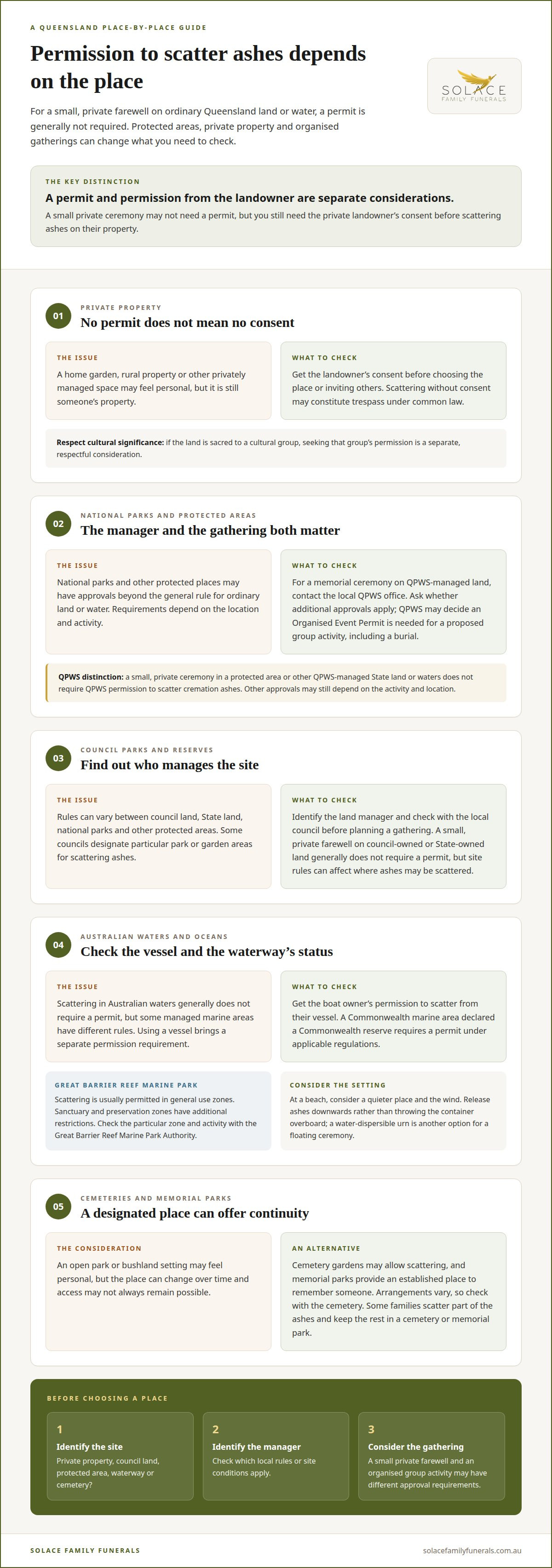
For a small, private farewell, a permit is generally not required on ordinary Queensland land or water. The answer can change in national parks, protected areas, organised gatherings and cemetery grounds, so identify who manages the site and check the relevant local rules.
QPWS permission for national parks
The approvals needed to scatter ashes in a Queensland national park can depend on the circumstances. This matters if you have chosen a bushland location such as Lamington National Park, the Daintree Forest or the Glasshouse Mountains.
For a memorial ceremony on QPWS-managed land, contact the local QPWS office to discuss the request. Check whether any additional approvals apply to your proposed ceremony. QPWS may decide whether an Organised Event Permit is required for a proposed group activity, including a burial. A small, private ceremony in a protected area or other QPWS-managed State land or waters does not require QPWS permission to scatter cremation ashes. The activity and location determine which approvals apply.
Scattering ashes in parks and reserves
In Queensland parks and reserves, approval depends on who manages the place and what kind of gathering you plan. A small, private farewell on council-owned or State-owned land generally does not require a permit, but some councils designate particular park or garden areas for scattering ashes.
Do you need council approval to scatter ashes in a park or reserve in Queensland? Permit requirements can depend on the location and type of gathering, so check with the land manager and local council before planning a memorial. Before choosing a site, identify whether it is council land, a national park or another protected area. Local rules and site conditions may affect where ashes can be scattered.
Cemeteries and memorial parks
Cemeteries and memorial parks offer designated places to scatter ashes, unlike an open park or bushland setting. In Queensland, cemetery gardens may allow scattering, while memorial parks can provide an established place to remember someone.
Options vary between cemeteries, so the relevant cemetery can explain its garden areas and arrangements. A memorial park may suit families who value a lasting place to visit; a chosen forest or mountain may feel more personal but can change over time. Some families divide the ashes, scattering some at a chosen place and keeping some in a cemetery or memorial park.
Permission to scatter ashes on private land
In Queensland, a small, private farewell on ordinary land generally doesn’t need a permit. If the place is privately owned, however, get the landowner’s permission before scattering cremated remains. Consent matters whether you’re considering a home garden, a rural property or another privately managed space.
Permission and permits are separate considerations. A permit may not be required for a small, private ceremony, but that doesn’t give you the right to enter or use someone else’s property. Scattering ashes on private property without the owner’s consent may constitute trespass under common law. Ask the owner before choosing the location or inviting friends to gather there.
A private farewell can be simple and personal, rather than a traditional funeral. You might gather with friends in a garden, share a few words and scatter the ashes with the owner’s agreement. If the land is sacred to a cultural group, seeking that group’s permission is also a respectful step. This ethical consideration is separate from the landowner’s consent.
Consider what the chosen place will mean to your family over time. A backyard memorial can feel close and personal, but you may lose access if you move. Some families scatter part of the ashes on private land and place the rest in a cemetery or memorial park. This can preserve a place to visit while honouring a personal connection to the land.
If a funeral director is helping with arrangements, explain that you’re considering a ceremony on private property and who owns the land. This helps align the cremated remains, ceremony and location details. The essential step is to get the landowner’s consent before making plans to scatter ashes there.
Scattering ashes in Australian waters and oceans
In Australia, a permit is generally not required to scatter ashes in waters or oceans. Environmental care still matters, and Commonwealth reserves have separate requirements.
Scattering ashes on or near water
Scattering ashes from a vessel or beside a waterway involves different practical considerations. You need the boat owner’s permission to scatter from their vessel, even when no general permit is required for scattering ashes in water.
At a beach, choose a quieter place near the water and consider the wind, so ashes are less likely to blow towards family members or back onto land. Release them downwards rather than throwing an ashes container overboard. The container may float away, leaving the remains behind in an unintended place.
A water-dispersible urn offers another option for a floating ceremony. Purpose-designed water urns can float with the tide and dissolve over time, releasing ashes into the water. The vessel, location and ceremony can all shape what feels right for your family.
Waterway environmental and health rules
There isn’t one permit rule for every Australian waterway. Scattering in a Commonwealth marine area declared a Commonwealth reserve requires a permit under applicable regulations. Great Barrier Reef Marine Park zones also differ: scattering is usually permitted in general use zones, while sanctuary and preservation zones have additional restrictions.
For Queensland locations inside the Great Barrier Reef Marine Park, contact the Great Barrier Reef Marine Park Authority about the particular zone and activity. The site’s management status matters because it can change which rules apply.
Ashes are highly alkaline and contain high levels of sodium; they may also contain trace chemicals or heavy metals. Disperse them rather than releasing a concentrated clump, and use an appropriate scattering technique. A water-soluble urn can support a floating ceremony, but don’t throw a non-dissolving container into the sea. These careful choices help respect the waterway and the meaning of the farewell.
Queensland rules and permits for scattering ashes
In Queensland, permit requirements depend on the location and who manages it. A private farewell on ordinary land or water is different from scattering in a protected area or Commonwealth reserve.
Permission requirements
For most small, private ceremonies on ordinary Queensland land or water, a permit isn’t generally required. The location matters: Commonwealth reserves have a specific permit rule, and places managed by councils or State authorities may have local conditions.
Under regulation 12.32 of the Environment Protection and Biodiversity Conservation Regulations 2000 (Cth), human remains may be buried in a Commonwealth reserve only in a burial area determined by the Director and with a permit. The regulations define “burial” to include scattering or other disposal of ashes that are or include human remains. This distinction matters if your chosen site is federally managed.
For a proposed memorial ceremony on land managed by Queensland Parks and Wildlife Service, speak with the local QPWS office about the activity. Local government permission is also needed for a memorial ceremony on a QPWS-managed area. A small, private farewell and an organised gathering may follow different approval processes.
Fines for scattering without permission
Whether a fine can apply depends on the rules for the particular site and what occurred. The general position that a small, private ceremony often needs no permit doesn’t override requirements for a protected area or Commonwealth reserve.
For example, scattering ashes in a Commonwealth reserve without the permit required under regulation 12.32 may breach that reserve’s rules. A site-specific requirement can also differ from the usual arrangements for land or water elsewhere in Queensland. Don’t treat the absence of a general permit requirement as permission to ignore a location’s restrictions.
Before arranging a ceremony, identify who manages the land or water and check the site’s status. If it is a Commonwealth reserve, the permit rule applies. If it is QPWS-managed, consider whether the gathering is a memorial ceremony or a small, private farewell. These distinctions are more useful than assuming one fine or permit rule covers every cemetery, park and waterway.
Solace Family Funerals
Solace Family Funerals can help with funeral and cremation arrangements once you’ve considered where scattering is permitted. If you’re deciding how to honour your loved one, options include Direct Cremation, Family Viewing, Full Service Cremation and Full Service Memorial.
The right choice depends on what feels meaningful for you and your family, including whether you want a gathering before or after cremation. You can talk through the kind of farewell you have in mind and the arrangements that could support it, without deciding every detail at once.
If you’d like to talk through funeral or cremation arrangements, contact Solace Family Funerals.
Make space for a farewell that feels right
Choosing where and how to say goodbye is personal. Take time to consider what matters most: a quiet moment, a gathering with family or a place you can return to. Understanding permission to scatter ashes in Queensland can help you make that choice with care, rather than feeling rushed by uncertainty.
You might also talk with family members about what the chosen place means to each of you. These conversations can help shape a farewell that feels considerate and shared, even when everyone has different wishes.
If you’re arranging a funeral or cremation alongside a scattering, Solace Family Funerals can help you consider the arrangements. Contact Solace Family Funerals to talk through what you have in mind. You can take the next step at your own pace, with a clearer sense of what feels meaningful for your family.
Frequently Asked Questions
Are there any rules around what you can and can't do with ashes?
Yes. The rules depend on the location and who manages it. On private property, get the owner’s consent; protected areas and Commonwealth reserves may have separate requirements. Also consider how you’ll handle the ashes: don’t throw a non-dissolving container into water, and avoid scattering them in a tight clump. If the land is culturally significant to a group, seek that group’s permission as a matter of respect.
Can you legally scatter ashes at an Australian beach?
Often, but the beach’s management arrangements matter. Many Queensland council beaches allow scattering, while councils may designate particular areas or set local conditions. A beach is also a shared public place, so choose a quiet spot and be mindful of other people nearby. If you plan a group memorial rather than a small, private farewell, the gathering may need different consideration from scattering ashes alone.
Will the place you choose always be there?
No place can be assumed to remain unchanged or accessible forever. A park or bushland area may be redeveloped, while a private backyard memorial can become difficult to visit after a move. Before choosing, consider whether family members will want a place to return to. Some families divide the ashes between a chosen location and a cemetery or memorial park, keeping another place for remembrance.
Do you need permission to scatter ashes in Queensland?
Usually, a small, private farewell on ordinary land or water doesn’t need a general permit, but permission can still matter. On private land, get the owner’s consent. First identify who manages the chosen site: a council park, QPWS-managed area and Commonwealth reserve may each have different requirements. Consider both the nature of the gathering and the status of the location.
What are Queensland's rules for scattering ashes on public land?
Public land isn’t managed under one set of arrangements. A council may set aside areas in a park or garden, while QPWS manages national parks and other protected areas. For a proposed group memorial on QPWS-managed land, the bereaved party’s representative should notify QPWS so it can decide whether an Organised Event Permit is needed. Local government permission is also relevant for memorial ceremonies on QPWS-managed areas.
Can you scatter ashes on a Queensland beach or in the sea?
Scattering ashes in Australian waters generally doesn’t require a permit, while Queensland council beaches may have local arrangements to consider. If you’re going by boat, get the vessel owner’s permission. Empty the ashes from a container rather than throwing the container overboard, as it may float away. At a beach, choose a place near the water and release ashes downwards, taking care around other people.


