
What if a farewell without a casket could feel just as complete, while giving your family more room to remember the person you love? It’s understandable to wonder what a memorial service without casket involves, or whether the gathering will feel personal without your loved one physically there. Its meaning comes from the people, stories and moments you bring together, not from one required format.
A memorial can take place after cremation, with or without the ashes present. You can choose a setting and timing that feel right for your family. Photos, favourite music, readings and shared memories can help shape a ceremony that reflects the person’s life. You don’t need to make every decision at once.
This guide explains how a casket-free memorial works, the choices you can consider and practical steps to get started. It also covers how Solace Family Funerals, an independent family-owned funeral home on the Gold Coast, can support a full-service memorial. The aim is to make your options clearer, so you can plan a welcoming tribute at a manageable pace.
Key Takeaways
- A memorial service without casket centres the gathering on remembrance, without the casket present as part of the ceremony.
- Start by agreeing on the purpose, timing, location and guest list. Then choose ceremony details together where that feels comfortable.
- Select a few personal touches that reflect your loved one. You don’t need to include every possible element.
- A casket isn’t the only way to make a farewell meaningful, even if some guests have different expectations of a memorial.
- On the Gold Coast, Solace Family Funerals offers a full-service memorial without the casket present or following cremation, with flexibility around location and timing.
What does a memorial service without a casket involve?
A memorial service without a casket is a gathering to remember someone, held without their casket present. The focus is on honouring their life and bringing people together, rather than viewing or accompanying the person’s physical remains during the ceremony.
The service may take place after cremation, with the ashes present or without them. It can also be arranged as a separate remembrance, giving family and friends time to gather when it suits them. A memorial service is commonly understood as a ceremony where the person’s body is not present, though the details can differ between families and traditions.
How a memorial differs from a funeral with the casket present
At a funeral where the casket is part of the ceremony, it may be present at the gathering, and the service can include a farewell at that time. A memorial has a different format: the casket isn’t there. Neither choice is more meaningful or respectful than the other. Families choose according to their wishes, beliefs and circumstances.
Without the casket as a focal point, the gathering can centre on shared stories, readings, music and time together. Some families display photographs or keepsakes; others prefer a simple service shaped by words and quiet reflection. There’s no single format that suits every family, culture or faith. The ceremony can reflect what feels appropriate to yours.
When families may choose a casket-free memorial
Some families choose to hold a memorial after cremation, separating the practical arrangements from the gathering to remember their loved one. Others want time to bring people together from different places or to arrange a ceremony around a meaningful location. The choice may also reflect the person’s wishes or what feels most comfortable for those closest to them.
There’s no need to treat the timing as a test of how much you care. A later gathering may give relatives and friends more opportunity to attend, while an earlier one may feel right for your family. Travel and personal circumstances can also shape the decision. Choose a time and format that allow people to gather in a way that feels considered.
When explaining the arrangement to guests, clear, gentle wording can set expectations. You might say that the service will be a gathering to remember your loved one and that the casket won’t be present. If ashes will be there, you can mention that too. This gives guests a clear picture of the ceremony without suggesting there’s one correct way to say goodbye.
For families on the Gold Coast, Solace Family Funerals offers a full-service memorial held without the casket present or following cremation. The location and timing can reflect your family’s wishes, helping you plan the kind of remembrance you want to share.
How to plan a memorial service without a casket, step by step
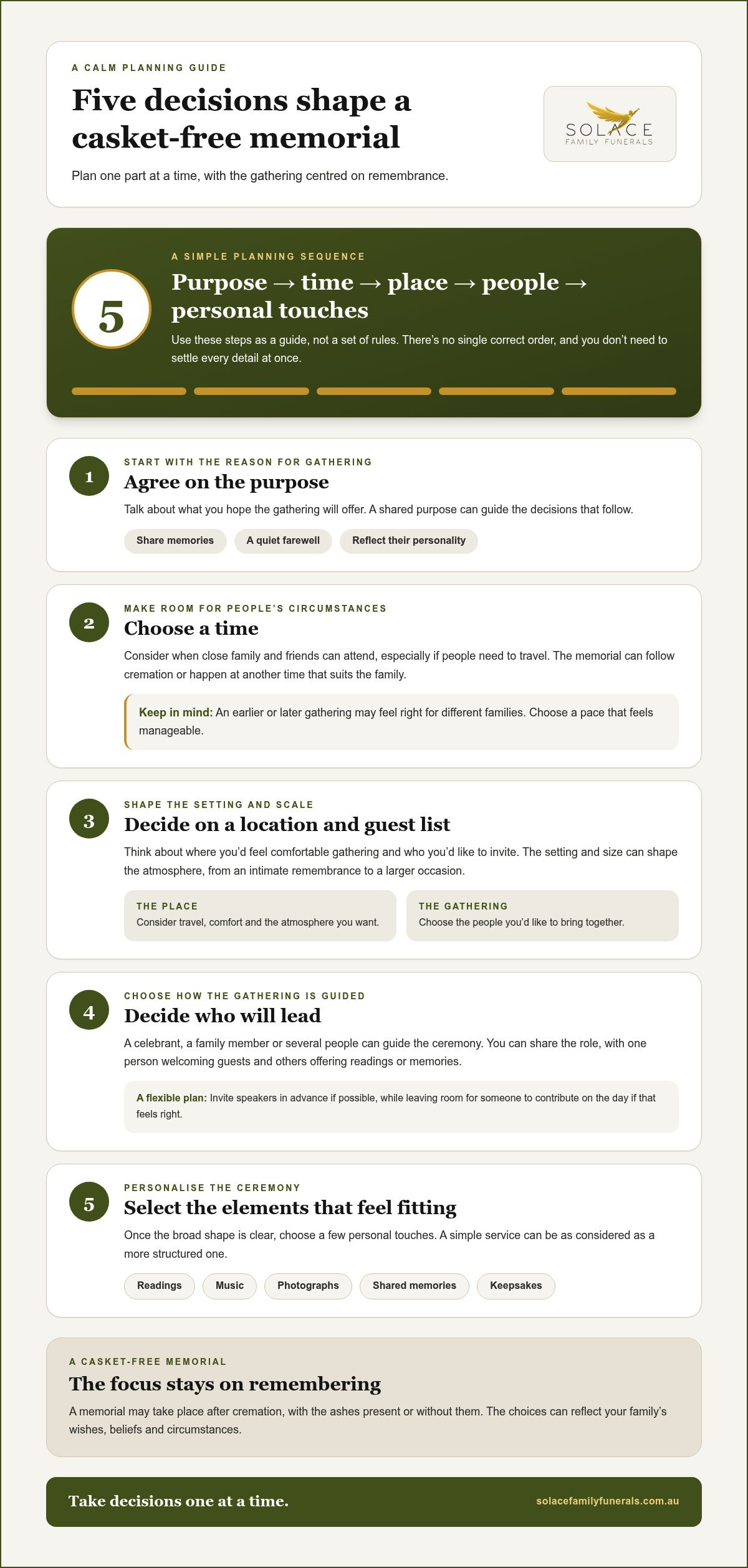
Planning can feel like a lot to manage while you’re grieving. You don’t need to settle every detail at once. Take decisions one at a time, involving family members or close friends where that feels comfortable. There’s no single correct order, so use these steps as a guide rather than a set of rules.
- Agree on the purpose. Talk about what you hope the gathering will offer: a chance to share memories, a quiet farewell or an occasion that reflects your loved one’s personality. A shared purpose can guide the decisions that follow.
- Choose a time. Consider when close family and friends can attend, especially if people need to travel. A memorial can take place after cremation or at another time that suits the family, giving you room to make plans at a manageable pace.
- Decide on a location and guest list. Consider where you’d feel comfortable gathering and who you’d like to invite. The setting and size can help shape the atmosphere, from an intimate remembrance to a larger occasion.
- Choose who will guide the ceremony. Decide whether a celebrant, a family member or several people will lead the gathering. You can invite speakers in advance and leave room for someone to contribute on the day if that feels right.
- Select the ceremony elements. Once the broad shape is clear, consider readings, music, photographs or other personal touches. Choose what feels fitting; a simple service can be as considered as a more structured one.
Choose a time, place and gathering size
When weighing up possible locations, consider how easy it will be for guests to travel there and move around comfortably. Think about the atmosphere you want: somewhere peaceful, familiar or connected to your loved one. Balance practical needs with family wishes. The right choice is one that feels workable and appropriate for those gathering.
Decide who will guide the ceremony
A celebrant can help organise and lead the proceedings, while a relative or friend may prefer to guide the gathering themselves. You could also share the role, with one person welcoming guests and others offering readings or memories. Let speakers know in advance if possible, but keep the plan flexible. Grief can affect what people feel ready to say on the day.
If you’d like more prompts for shaping the occasion, this memorial service planning guide can help you work through the choices. You might find it easier to record decisions as you make them, then revisit the list together rather than trying to remember everything at once.
On the Gold Coast, Solace Family Funerals offers a full-service memorial without the casket present or following cremation, with flexibility around location and timing. Read about Solace’s full-service memorial to learn more.
What can you include in a memorial service without a casket?
Without a casket, personal details can give the gathering a shared focus. You might choose a few things that bring your loved one to mind, such as a favourite song, a photograph, a familiar saying or a story that makes people smile. These aren’t requirements. A quiet, simple ceremony can feel just as considered as one with several planned contributions.
Personal choices, from a much-loved song to a shared story, can shape a ceremony that feels true to the person being remembered.
As you plan, consider what feels most like them and what guests may find comforting. You don’t have to recreate every part of their life or fill every moment. Choose a small number of meaningful details, and leave space for people simply to be together.
Personal tributes, music and shared memories
Invite willing guests to prepare a brief story, reading or reflection, while making it clear that listening is also a meaningful way to take part. A favourite piece of music or a small selection of photographs can create a familiar atmosphere without elaborate arrangements. If you’d like a visual focus, display a few images or keepsakes where guests can see them.
- Spoken tributes: A short memory, reading or a few words from someone close.
- Music: A song that mattered to your loved one or brings a particular memory to mind.
- Photographs and keepsakes: Selected items that help guests recall shared moments.
- Quiet reflection: A pause for guests to remember privately, without being asked to speak.
A simple ceremony order families can adapt
A loose sequence can help the gathering feel connected while leaving room for emotion and unplanned moments. Keep contributions manageable and let people know what to expect, but don’t feel bound to follow a formal programme. Adjust the order to suit your family, the setting and the tone you want.
- Welcome: A few words to greet guests and explain why you’ve gathered.
- Reflections: A reading, music or brief introduction to your loved one’s life.
- Tributes: Stories or messages from invited speakers who feel comfortable sharing.
- Quiet pause: A moment for everyone to reflect in their own way.
- Closing words: A gentle ending and a chance to acknowledge those gathered.
It can help to choose one person to keep an eye on the flow, especially if several people plan to speak. They can gently move things along or leave a pause if emotions rise. The plan is there to support you, not make the ceremony feel scripted. If a contribution needs to change on the day, that’s all right.
Will a memorial without a casket still feel meaningful?
It’s natural to wonder whether a gathering will feel complete without the casket, particularly if that’s the kind of farewell you’ve attended before. But a casket isn’t the only way to give a memorial meaning. The care people bring, the memories they share and the time spent together can all help honour someone’s life. A memorial can be meaningful without a casket, while leaving each person free to remember in their own way.
A memorial service without casket may be unfamiliar to some guests or different from what they expected. That doesn’t mean you need to defend your decision or follow a particular tradition. A little clear information can help guests understand why you’re gathering and what to expect, so they arrive feeling more prepared.
Helping guests understand what to expect
You can explain the format in a few straightforward words, without sharing more than feels right. For example: “Please join us for a memorial to remember and celebrate Alex’s life. The casket won’t be present; we’ll gather for stories, reflection and time together.” Adapt the wording to suit your family and the occasion. If ashes will be present, you may choose to mention that too.
Include practical details that will help people attend and feel at ease. Give the location and start time, and explain anything about the format that guests may otherwise be unsure of, such as whether there will be speakers or a shared moment of reflection. You can also welcome guests at the beginning and explain the purpose of the gathering: a chance to remember, listen and be together. Clear expectations leave more room for the occasion itself.
Making space for different ways of grieving
People respond to loss differently. One guest may want to share a story, while another may prefer to listen quietly or take a moment alone. Neither response needs to be explained or corrected. If it suits the setting, you could make a quieter spot available or include a pause during the ceremony, but these are options, not requirements. There’s no need to ask everyone to speak, join in or show emotion in a particular way.
You might also prepare a gentle response if someone is surprised by the format. For instance, you could say, “We wanted this time to focus on remembering them together.” You don’t need to persuade every guest that your choice is right. A calm explanation can acknowledge their expectations while keeping the focus on the person being remembered.
If you’re considering this kind of farewell on the Gold Coast, Solace Family Funerals offers a full-service memorial without the casket present or following cremation. Explore a full-service memorial as an option for planning a ceremony that reflects your family’s wishes.
Arranging a casket-free memorial on the Gold Coast
Once your family has decided that a memorial without the casket present feels right, you can shape the ceremony around what matters to you. Solace Family Funerals is an independent, family-owned funeral home on the Gold Coast and offers a full-service memorial without the casket present or following cremation. Families can choose the location and timing, giving you room to plan a gathering that reflects your wishes.
If the memorial will follow direct cremation, it may help to think of the arrangements as two connected decisions: the cremation and the time you’ll set aside to remember your loved one. Solace’s guide to holding a memorial after direct cremation offers further perspective on planning a gathering after cremation.
What support can look like when arranging a memorial
Planning while grieving can make even straightforward choices feel difficult. A calm conversation can help you work through what you hope the memorial will feel like, who you’d like to gather with and what matters most to your family. You don’t need to arrive with a finished plan. It’s enough to begin with an idea, a question or a wish you’d like to explore.
Solace can listen to your family’s preferences and explain the choices involved in arranging a full-service memorial. You can discuss how the location and timing might reflect your wishes and consider what kind of gathering feels appropriate. The aim is to make the options clear, without pressure to settle every detail at once.
It can help to share a few starting points: whether you’re considering a memorial after cremation, what you want guests to remember, or any particular wishes your loved one expressed. If family members have different views, you can talk about those too. You may not agree on every detail straight away, and that’s all right. A thoughtful conversation can clarify what matters most before you make further decisions.
A gentle next step for Gold Coast families
You don’t have to know the location, ceremony order or guest list before seeking guidance. If you’re still working out what a memorial could look like, begin with what you know: perhaps the atmosphere you hope for, a preferred time, or simply that you’re considering a service without the casket present. The conversation can develop as your family feels ready.
There’s no need to rush into a decision. Take one step, pause when you need to, and return to the next choice when it feels manageable. If you’d like to discuss a memorial service without casket on the Gold Coast, talk with Solace Family Funerals. You can begin with a conversation, even if some details are still undecided.
Take the next step at your own pace
You don’t need every detail settled before you begin. A helpful first step may be to share one thing you hope the gathering will honour, such as a family wish, a particular feeling you want the day to hold, or simply the chance to spend time remembering together. From there, the next decision may become clearer.
If you’re considering a memorial service without casket, it’s all right to take time, talk with those closest to you and seek guidance as questions arise. Solace Family Funerals is locally family-owned and operated on the Gold Coast, and can help you discuss a full-service memorial held without the casket present or following cremation. You don’t need to arrive with a finished plan.
When you feel ready, talk with our caring team about a memorial service. Begin with a conversation and take the planning one step at a time, at a pace that feels right for your family.
Frequently Asked Questions
Can you have a memorial service without a casket?
Yes, families can hold a memorial service without a casket. The ceremony can be arranged separately from decisions about burial or cremation, and your family can decide whether ashes will be present. You can also choose who to invite and whether the gathering will feel formal or informal. If guests might expect a traditional funeral, explain plainly what kind of ceremony you’re planning so they know what to expect.
What happens at a memorial service without a casket?
The gathering usually centres on remembering the person, rather than on a casket or committal. The person guiding the ceremony might welcome guests, introduce a tribute or reading, and invite people to reflect. The details depend on your family’s wishes. Let guests know beforehand whether there will be planned speakers, a chance to contribute or a more informal gathering, so they can decide how they’d like to take part.
Is a memorial service without a casket still a funeral?
People may use “funeral” and “memorial” differently in everyday conversation, so it can help to describe the event by its format. A funeral service often includes the casket, while a memorial is held without it. Both can be occasions to honour someone who has died. If you’re unsure what wording to use, choose the term that best explains the gathering to your family and guests.
Can a memorial service without a casket take place after cremation?
Yes. A memorial can be held after cremation, allowing the family to arrange a separate time to gather. The ashes may be present, or the ceremony can focus on remembrance without them. If guests are likely to wonder about this, include a brief note in the invitation. This helps everyone understand the format before they arrive.
How do you make a memorial service without a casket personal?
Choose details with a clear connection to the person, rather than trying to include everything they enjoyed. You might ask a few close relatives to share one memory each, then choose a reading or piece of music that fits the stories they tell. If contributions are collected beforehand, you can decide what feels suitable and let guests know whether they’ll be invited to speak or simply listen.
Where can you hold a memorial service without a casket on the Gold Coast?
Solace Family Funerals offers a full-service memorial on the Gold Coast, with flexibility around location and timing. The setting can reflect your family’s wishes and what will make the gathering comfortable for those attending. As you consider the location, think about how guests will get there and whether the space suits the atmosphere you hope for. You don’t need to have a place chosen before exploring the options.
What should guests expect at a memorial service without a casket?
Guests should know that the casket won’t be present and have a general sense of how the gathering will unfold. Your invitation can explain whether ashes will be there, who will lead the ceremony and whether guests are welcome to share a tribute. There’s no expectation that everyone will speak. Some people may prefer to listen quietly, and they can honour the person in their own way.


